Foundations of care
Perioperative care
NCLEX perioperative chapter: PACU airway priorities, atelectasis and clot prevention, hemorrhage and evisceration, malignant hyperthermia, and procedure-specific aftercare.
ClesialReviewed by Sophia Bennett, RN
Contents11 sections
Perioperative nursing is pattern recognition across three windows: keep the airway and lungs open after anesthesia, catch the complications that kill in the first hours to days, and match each diagnostic procedure to its own position and watch-for list.
PACU and early recovery: airway first
While the client is still drowsy from general anesthesia, oxygenation and airway patency outrank comfort and teaching. Snoring respirations with a falling saturation usually mean soft-tissue obstruction. Reposition and open the airway before you assume the problem is only the nasal cannula.
- Confirm return of protective reflexes before oral intake, especially after bronchoscopy or topical throat anesthesia.
- Pain control matters because a client who will not expand the chest will atelectasize. Treat pain so incentive spirometry is possible.
- If the client ate a full breakfast after NPO instructions, stop the morning-of flow and notify anesthesia and the surgeon.
Prevent the usual postoperative traps
The complications that fill exam stems are often the ones you were supposed to prevent yesterday: collapsed alveoli, clots from a still client, and a diet advanced before the gut was ready. Prevention is not busywork - it is the plan that keeps the client off the hemorrhage and airway pathways you escalate later.
| Risk | What you do | Why it shows up on the exam |
|---|---|---|
| Atelectasis / pneumonia | Incentive spirometer, turn-cough-deep breathe, early ambulation, sitting up for lung expansion | IS purpose is alveolar expansion, not “exercise the arms” |
| DVT / PE | Early ambulation, sequential compression, anticoagulation when ordered, leg exercises in bed | Immobility plus surgery is the classic clot setup |
| Ileus / delayed diet | Confirm appropriate bowel/gastric readiness before advancing diet per order | First PO after abdominal surgery is not automatic with wakefulness alone |
Atelectasis wins when shallow breathing wins. Pain, narcotics, and “I’ll do the spirometer later” leave the bases closed; incentive spirometry and turn-cough-deep breathe exist to reopen alveoli, not to give the arms a workout. Early ambulation does double duty - lungs and veins - so bed rest “until they feel like it” is the distractor that looks kind and causes both pneumonia risk and clot risk.
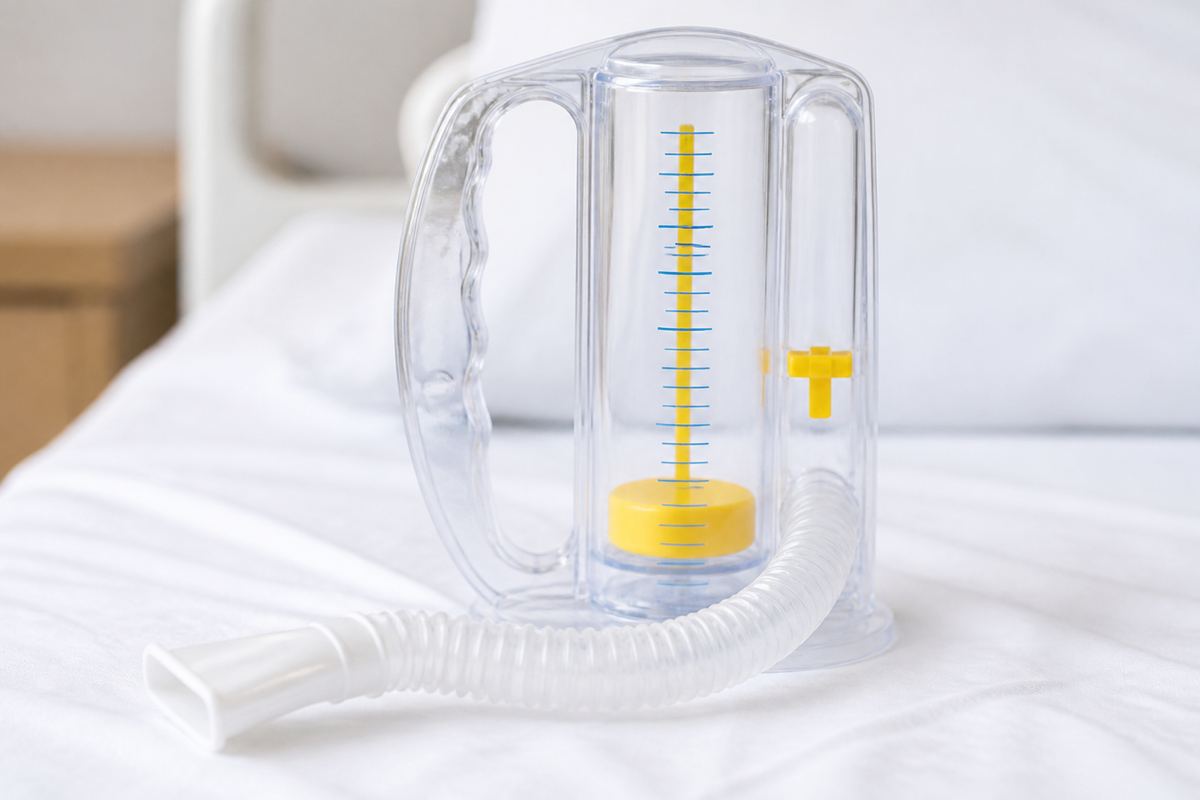
Clot prevention is mechanical plus pharmacologic when ordered: compressions, leg exercises, and getting the client up as soon as the surgeon’s plan allows. Diet advancement is a gut readiness decision - bowel sounds, flatus, or the protocol the stem gives you - not a prize for opening their eyes. The distractor that looks efficient is advancing diet because the client is awake, or skipping ambulation “until pain is zero.”
Hemorrhage and shock after surgery
In the first hours, bright red saturation of a dressing plus restlessness, tachycardia, and falling blood pressure is hemorrhage until proven otherwise. Support the site (direct pressure when appropriate), keep IV access open, prepare for fluid/blood orders, and notify the surgeon. A firm, distending abdomen with the same vital-sign slide can mean internal bleeding even when the outer dressing looks quieter.
Hypothermia after long anesthesia slows clotting and recovery - warm the client as ordered and watch for shivering that raises oxygen demand. Postoperative urinary retention is common after anesthesia and anticholinergic drugs; bladder scan or straight catheterization follows orders when the client cannot void and the bladder is full. Wound drains (Jackson-Pratt, Hemovac patterns) stay compressed to suction as designed; sudden stop of drainage with swelling at the site can mean a clot blocking the tube or a collection forming - assess and notify rather than milking aggressively against policy.
Wound failure: dehiscence vs evisceration
Both are surgical wound failures, but they are not the same emergency. Dehiscence is separation of the incision edges. Evisceration is when an organ - usually bowel - is outside the wound. The shared first moves are stay with the client, protect the site, reduce tension, keep NPO, and get the surgeon. The hard line is evisceration: cover and call - never push bowel back in.
| Finding | Action |
|---|---|
| Incision edges separate (dehiscence) | Stay with client, cover with sterile dressing (often saline-moist), low Fowler's, notify surgeon, keep NPO |
| Organ/bowel protrudes (evisceration) | Sterile saline-moistened dressings over the bowel, low Fowler's with knees bent if ordered/protocol allows, **do not replace bowel**, call surgeon now |
Why saline-moist sterile cover and low Fowler’s: you protect exposed tissue from drying and contamination, and you take strain off the incision while help is coming. Knees bent (when protocol allows) is the same idea - less abdominal wall pull. NPO anticipates a return to surgery. The distractor that looks decisive is stuffing the bowel back into the abdomen or treating evisceration like a routine dry dressing change.
Stems often cue with a sudden pop or give after coughing, vomiting, or straining, then either an open wound or visible loops. Cover, position, notify - do not stop to teach incentive spirometry or chase a full set of labs first. Chronic pressure-injury staging and long-term wound-care detail stay in Wound and pressure injury care; this section owns acute dehiscence and evisceration response.
Named postoperative emergencies
Malignant hyperthermia
Soon after volatile anesthetics or succinylcholine: rapidly rising temperature, jaw/muscle rigidity, tachycardia, rising end-tidal CO2. This is a crisis protocol, not a cooling blanket alone. Stop triggering agents, give dantrolene as ordered, support ventilation, cool, and call for help.
Compartment syndrome
After cast or crush/fracture care: pain out of proportion, pain with passive stretch, tightness, pallor or delayed refill, paresthesias. Report immediately. Do not assume another opioid dose will fix a mechanical pressure emergency.
Fat embolism
Hours to a day or two after long-bone repair: sudden confusion, hypoxemia, and a petechial rash (often chest/axilla). Oxygen and escalate. Do not chalk it up to “waking up weird from anesthesia” when the triad appears late.
Post-thyroidectomy airway and calcium
Neck hematoma, stridor, or progressive dyspnea is an airway emergency. Perioral tingling and neuromuscular irritability flag hypocalcemia from parathyroid disturbance. Both need prompt recognition; the noisy neck comes first.
Safety
If findings point to hemorrhage, evisceration, malignant hyperthermia, compartment syndrome, or airway compromise after neck surgery, escalate now. Comfort measures alone are not the priority action.
Diagnostic procedures: aftercare that matches the hole you made
Each invasive test has one or two aftercare rules the exam loves. Memorize the position and the “call now” finding.
| Procedure | Immediate care / teaching | Watch for |
|---|---|---|
| Percutaneous liver biopsy | Right side-lying to compress the site; limited activity per order | Bleeding, peritonitis signs, rising pain |
| Bronchoscopy (topical airway anesthesia) | NPO until gag returns | Aspiration if fed too early; respiratory distress |
| Large-volume paracentesis | Monitor BP and volume status closely in first hours | Hypotension / hypovolemia after fluid shift |
| Thoracentesis | Respiratory assessment after the procedure | Sudden severe dyspnea and falling SpO2 → possible pneumothorax |
| Renal biopsy | Pressure/rest per protocol; monitor vitals and urine | Hypotension, tachycardia, expanding flank pain/bruising → bleeding |
| Lumbar puncture | Flat rest as ordered; fluids if allowed | Post-dural headache worse upright, better flat (afebrile, soft neck) |
| Bone marrow biopsy (iliac crest) | Firm pressure on the puncture site | Ongoing bleeding at the site |
| EGD / colonoscopy / ERCP | NPO until safe to swallow; ERCP teaching includes pancreatitis watch | Colonoscopy: rigid abdomen / severe pain after polypectomy → perforation; ERCP: severe epigastric pain radiating to back |
| MRI | Screen metal implants, aneurysm clips, some pacemakers/ICDs, metal fragments, incompatible pumps | Cancel or clarify before the magnet, not after |
Discharge teaching that sticks
Ready for home means stable vitals, controlled pain on oral meds when that is the plan, voiding, tolerating the ordered diet, and understanding wound care, infection cues, activity limits, and who to call. Teach incentive spirometry and ambulation to continue at home when ordered. Driving, heavy lifting, and sexual activity follow surgeon timelines - inventing “you’re fine for the gym tomorrow” after major abdominal surgery fails the stem. Preoperative consent and checklist details live in Preoperative care.
Priority map
- Noisy or obstructed airway / falling SpO2 → open airway and oxygenate.
- Saturating bright-red dressing with shock vitals → hemorrhage pathway.
- Bowel outside the incision → saline-moist sterile cover; do not reduce.
- Rigidity + soaring temperature under anesthesia → malignant hyperthermia protocol.
- Named procedure + classic complication cue → treat that complication, not a generic “rest and reassess.”
Revision
Must know
- 1PACU first: airway and oxygenation. Snoring with falling SpO2 → open the airway (jaw thrust / reposition) before chasing other causes.
- 2Prevent atelectasis: incentive spirometry, turn-cough-deep breathe, early ambulation, pain control that lets the client expand the chest.
- 3Before first oral intake after anesthesia or throat topical anesthesia: confirm return of the gag reflex.
- 4NPO broken on the morning of surgery: hold, notify anesthesia/surgeon. Do not quietly proceed.
- 5Hemorrhage picture: saturating dressing, restlessness, tachycardia, falling BP → pressure/support per wound type, IV access, notify surgeon now.
- 6Evisceration: cover protruding bowel with sterile saline-moistened dressings, low Fowler's, do not push bowel back, call the surgeon.
- 7Malignant hyperthermia: rising temperature, muscle rigidity, tachycardia, rising ETCO2 → stop triggering agents, give dantrolene, cool, support ABCs.
- 8Compartment syndrome: pain out of proportion, worse with passive stretch, tight/swollen limb → report immediately; do not elevate past heart level as the only “fix.”
- 9Fat embolism after long-bone repair: sudden confusion, hypoxia, petechial rash on chest/axilla → oxygen and escalate.
- 10Thyroidectomy airway: neck swelling, stridor, or progressive dyspnea is an emergency. Perioral tingling flags hypocalcemia risk.
- 11Procedure positions/watchouts: liver biopsy → right side; bronchoscopy → gag before PO; thoracentesis sudden dyspnea → pneumothorax; post-LP headache worse upright → flat rest.
Memory hooks
Airway before tray
Snoring, obstructed breathing, or no gag reflex beats offering water, getting a full set of labs, or teaching IS in that minute.
Cover, don't stuff
Eviscerated bowel gets a sterile saline-moist cover and a surgeon call. Never push the loop back into the wound.
Right side after liver poke
After percutaneous liver biopsy, place the client on the right side to compress the puncture site and reduce bleeding risk.
On the exam
How it's tested
Stems stack PACU vitals with snoring, a soaking dressing with shock cues, an open incision with bowel visible, or a named procedure with one wrong aftercare action. Distractors offer food before gag returns, elevate a compartment limb as the whole plan, push bowel back in, or treat malignant hyperthermia like a simple fever.
More in foundations of care
All topics- Adult physical assessmentNCLEX adult assessment chapter: exam order, lung and heart findings to report, perfusion checks, neuro/LOC, pain tools, and abdomen red flags.Read
- Electrolytes: sodium, potassium, calcium, magnesium, phosphateNCLEX electrolytes chapter: Na, K, Ca, Mg, and phosphate. Role, low vs high tables, treatment order, and food plates for diet teaching.Read
- Elimination careNCLEX elimination chapter: incontinence types, retention and oliguria, CAUTI prevention, impaction versus diarrhea, enemas, and stoma color emergencies.Read
- Fire safetyNCLEX fire safety chapter: RACE and PASS, oxygen fire risk, evacuate ambulatory clients first patterns as tested, and never use elevators during a fire.Read