Professional practice
Priority frameworks: ABCs, Maslow, and who to see first
NCLEX prioritization map: airway-breathing-circulation first, Maslow physiologic before psychosocial, acute versus chronic, and unstable before stable.
ClesialReviewed by Sophia Bennett, RN
Contents8 sections
Prioritization items ask one question: who is closest to harm right now. Ethics of consent and DNR comfort live in Ethics and care coordination. Who may hold a task lives in Delegation and assignment. Disaster color tags live in Emergency and disaster triage. This chapter owns the frameworks you use when several clients compete in ordinary care.
ABCs before everything else
Airway, breathing, and circulation are not a slogan. They are the order in which death arrives. An obstructed airway or failing ventilation kills faster than a dressing that needs changing or a client who wants to talk about discharge fears. When the stem shows stridor, silent chest, SpO2 crashing, new cyanosis, or a client who cannot speak in full sentences, you go there first.
| Cue | Why it wins the queue |
|---|---|
| Stridor / can't speak / choking | Airway may close |
| Rising CO2, tiring, falling LOC | Ventilatory failure |
| SpO2 falling, cyanosis, air hunger | Oxygenation failure |
| Hypotension, cool clammy, chest pain with shock signs | Circulation / pump failure |
| Sudden mentation change | Brain perfusion or hypoxia until proven otherwise |
Work airway then breathing then circulation unless the stem already shows a dead patient (no pulse), in which case CAB-style CPR logic takes over. The distractor that looks caring is sitting with the crying stable client while the quiet one in the corner turns blue. Noise is not acuity. Edge case: if the stem already shows apnea or no pulse, you do not assess further first. You rescue.
Maslow: physiologic before psychosocial
Maslow's hierarchy is a prioritization tool on the exam, not a therapy lecture. Lower tiers must be reasonably secure before higher ones drive the first action. Oxygen, circulation, fluid balance, elimination, and uncontrolled pain that threatens stability sit under physiologic. Fall risk and infection control sit under safety. Loneliness, anxiety teaching, and self-esteem work matter after the body is not crashing.
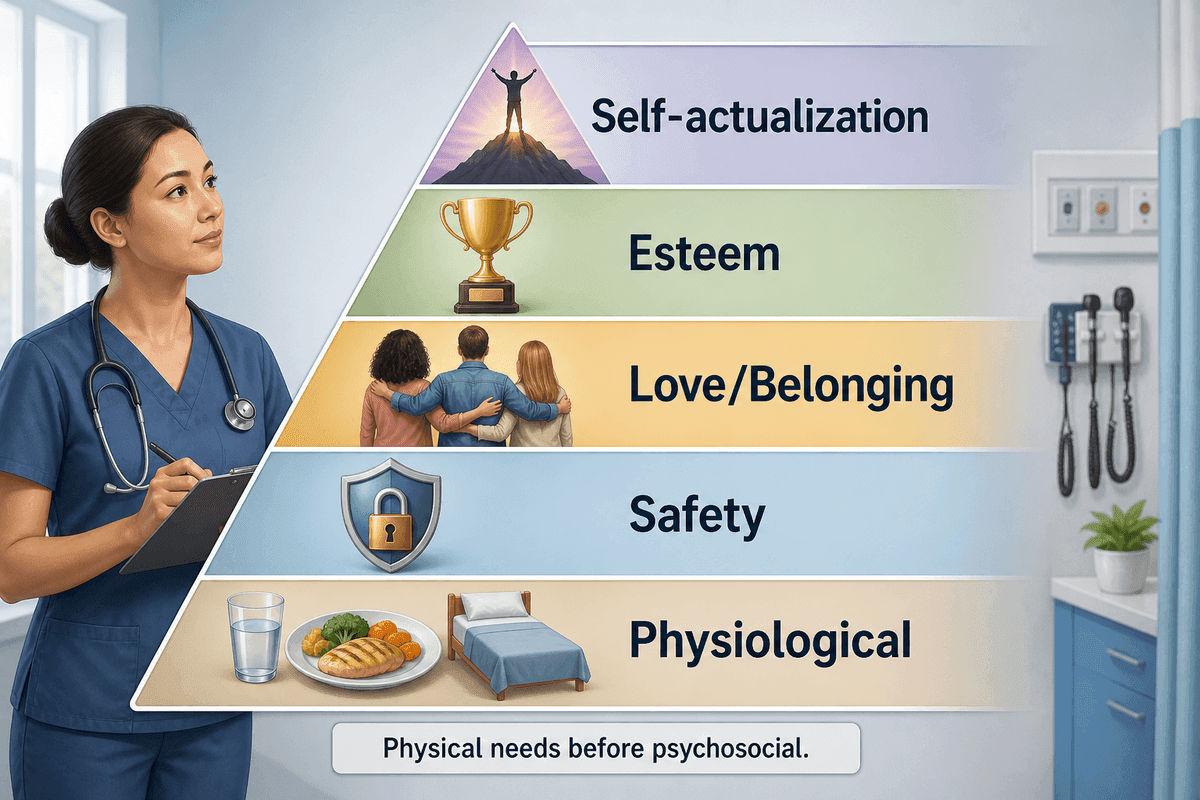
| Tier | Exam pictures |
|---|---|
| Physiologic | Hypoxia, shock, hemorrhage, severe pain with instability, inability to void with bladder damage risk |
| Safety | Fall risk, isolation, suicide means restriction, unsafe home |
| Love / belonging | Support persons, isolation distress once stable |
| Esteem / self-actualization | Body-image teaching, long-term goals. Rarely first after report |
Why this traps people: anxiety looks urgent because it is loud. A client sobbing about a new diagnosis is real suffering, but a client with SpO2 84% who says little is closer to arrest. Treat anxiety after you protect gas exchange, or treat both if you can without leaving the hypoxic client alone. Suicide risk is a safety-tier emergency once ideation with plan appears. It can outrank routine physiologic comfort tasks, but it does not outrank an obstructed airway in the next bed.
Acute versus chronic, unstable first
Stack these filters when ABCs look similar across clients. Unstable means the baseline just broke or never existed (new admission, fresh OR, changing vitals). Acute beats chronic when both need you. Unexpected beats expected side effects the stem already labeled as normal for that disease.
| Filter | See first | Can usually wait |
|---|---|---|
| Stability | Falling BP, new confusion, fresh chest pain | Long-stable chronic complaint with usual vitals |
| Acute vs chronic | New stroke symptoms, new severe dyspnea | Chronic stable COPD requesting routine teaching |
| Expected vs unexpected | Unexpected stiff neck with fever | Expected low-grade ache after known procedure, stable vitals |
| Time since change | Just returned from OR / just admitted | Day-three stable recovery wanting a bath |
- See first: new post-op with falling BP, fresh stroke symptoms, new confusion, chest pain with diaphoresis.
- Can wait: chronic stable COPD requesting routine teaching, expected low-grade ache after known procedure with stable vitals.
- Assess before implementing when the next finding would change the plan, unless ABC rescue is already clear.
Chronic disease is not automatically low priority. Chronic heart failure with new pink frothy sputum is acute-on-chronic and wins. The word chronic in the stem is a clue only when the complaint is the client's usual baseline. The distractor that looks organized is finishing morning meds on four stable clients before checking the one whose family says he is not himself.
Safety
When in doubt after report, go to the client who cannot protect the airway, cannot oxygenate, or just changed unexpectedly.
A practical order after report
- Scan for ABC threats across the assignment.
- Among remaining clients, pick unstable or unexpected change next.
- Prefer acute over chronic baseline complaints when acuity is otherwise similar.
- Use Maslow when the leftover choice is physiologic versus psychosocial.
- Assess before non-rescue actions when data would change the plan.
This order prevents the common exam error of jumping straight to a psychosocial or teaching task because it feels productive. Productivity is not priority. Survival and stability are.
Priority map
| Picture | First move |
|---|---|
| Four clients after report | ABC / most unstable first |
| Anxious stable vs quiet hypoxic | Hypoxia wins |
| Pain teaching vs new stridor | Airway |
| Chronic complaint vs new mentation change | New change |
| Acute asthma flare vs chronic arthritis pain | Acute respiratory threat |
| Unsure what the numbers mean | Assess before a non-rescue action |
Revision
Must know
- 1ABCs first: a client who cannot protect the airway or oxygenate outranks almost every other task.
- 2Maslow: physiologic needs (oxygen, circulation, fluids, elimination, pain that threatens stability) before safety/security, then psychosocial.
- 3Unstable / acute / unexpected before stable / chronic / expected.
- 4Acute beats chronic when both need you and ABCs look similar. New change beats expected baseline complaint.
- 5Assess before you act, unless a clear ABC rescue is already obvious (choking, apnea, pulselessness).
- 6Fresh admissions, new post-ops, and changing conditions compete for RN eyes before routine teaching on a stable client.
- 7Delegation and scope live in Delegation and assignment. Consent and DNR ethics live in Ethics and care coordination.
Memory hooks
Airway before paperwork
When four clients compete after report, the one who cannot breathe or oxygenate wins the first assessment.
Body before feelings
Maslow puts oxygen and perfusion above anxiety teaching when both appear in the same stem.
New and noisy? New wins
Unexpected change and acute instability beat expected chronic complaints, even loud ones.
On the exam
How it's tested
Stems list several clients after report and ask who to see first, or pit an anxious stable client against a quiet hypoxic one, or an acute change against a chronic baseline complaint. Distractors pick psychosocial comfort, scheduled meds, or a chronic complaint over airway and acute change.
More in professional practice
All topics- Client rights, restraints, and reportingNCLEX legal chapter: negligence elements, restraint least-restrictive rules, mandatory reporting, incident reports, HIPAA basics, and refusal of care.Read
- Culture and spiritual careNCLEX culture chapter: assess instead of stereotype, use qualified interpreters, honor diet and ritual when safe, and keep spiritual care in the client’s definition.Read
- Delegation and assignmentNCLEX management map: RN, LPN/LVN, and UAP scope, five rights of delegation, and why stability beats the task label.Read