Adult health
Wound and pressure injury care
NCLEX wound chapter: pressure-injury staging, prevention for immobile clients, surgical infection cues, and diabetic foot and hygiene rules.
ClesialReviewed by Sophia Bennett, RN
Contents7 sections
Wound items on this topic are almost always staging from a description and prevention for the client who cannot turn alone. Learn the words; do not rely on a photo to carry the answer. Acute burn and inhalation injury priorities live in Burns and inhalation injury.
Stage from the description
Pressure injury staging names how deep the damage goes. The exam will give tissue depth in words; intact versus open, fat versus bone, slough covering the base; because photos can mislead and because staging is a clinical description skill. Stage by the deepest tissue you can see; do not “average” a wound that has different depths at different edges.
| Stage / category | What the stem describes | Why that depth matters |
|---|---|---|
| Stage 1 | Intact skin, localized non-blanchable redness | Capillary damage under closed skin; still reversible if offloaded |
| Stage 2 | Partial-thickness open area or serum-filled blister | Epidermis/dermis lost; still shallow, no fat on view |
| Stage 3 | Full-thickness to subcutaneous fat; no bone/tendon/muscle | Fat visible; tunneling/undermining may appear |
| Stage 4 | Bone, tendon, or muscle visible | Deepest category; osteomyelitis risk rises |
| Deep tissue injury | Maroon/purple intact skin, often boggy or firmer than nearby tissue | Damage started in deep tissue; surface may open later |
| Unstageable | Base hidden by slough or eschar | You cannot name depth until the base is visible (stable heel eschar rules follow wound-care orders) |
Non-blanchable means the redness stays when you press; the vessels are already injured or engorged in a way that does not empty and refill like ordinary reactive hyperemia. That is why Stage 1 is not “a little pink from lying there.” Deep tissue injury looks like a bruise that will not behave like a bruise: persistent deep color over a pressure point, often with a boggy or mushy feel. Do not document it as a simple contusion and walk away.
Darker skin tones make erythema harder to see. Compare to the client’s baseline and opposite side; look for warmth, firmness, bogginess, or purple/maroon hues over bony prominences. The distractor that looks race-neutral is waiting for textbook bright red before calling Stage 1.
Prevention for the immobile client
Pressure injury starts when body weight pins soft tissue between bone and the mattress (or chair) long enough that capillaries close and cells die. Time and intensity both matter: high pressure for a short time or moderate pressure for a long time can injure. The immobile client cannot shift that load alone, so your schedule; not their discomfort; is what keeps blood flowing under the sacrum, heels, trochanters, and elbows.
- Turn and reposition on a schedule (commonly every 2 hours in bed unless ordered otherwise; chair-bound clients need more frequent small shifts).
- Keep heels floated; use pillows to keep bony prominences off the mattress.
- Manage moisture; clean gently; barrier cream as ordered; incontinence softens skin so shear tears it.
- Reduce shear when boosting up in bed; lift with help, do not drag.
- Support protein/calorie intake and hydration as allowed; repair needs building blocks.
- Use support surfaces as ordered; they help redistribute pressure; they do not replace turning.
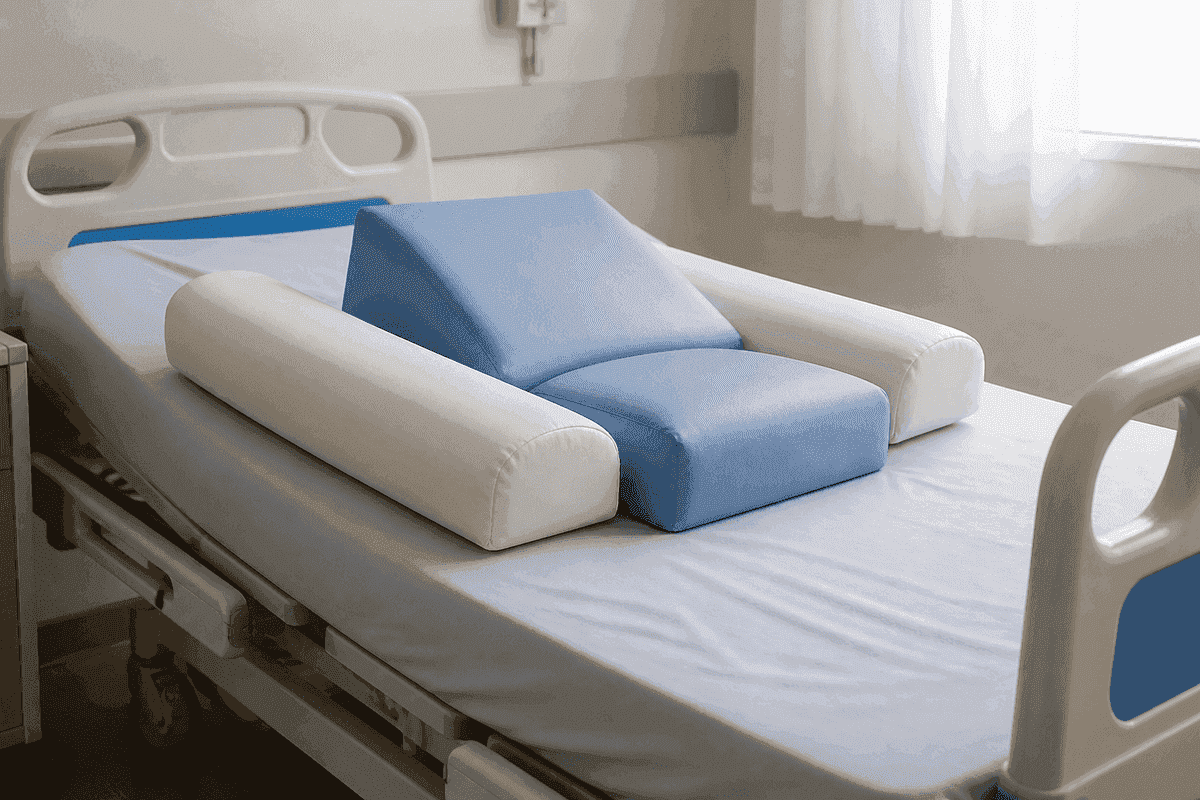
Pressure is the perpendicular force that collapses capillaries. Friction is skin rubbing on sheets. Shear is friction plus gravity: the skeleton slides while the skin sticks, stretching and tearing vessels under intact skin. That is why dragging a client up in bed can create deep injury that later declares as Stage 3 or deep tissue injury even when the surface looked fine yesterday. Lift with enough help; use slide sheets as taught; keep the head of bed as low as the clinical picture allows when shear risk is high (balance against aspiration and breathing needs).
Moisture from sweat, urine, or wound drainage macerates the outer skin so friction peels it more easily. Clean gently, dry thoroughly, and use barrier products as ordered; scrubbing with harsh soap adds friction injury on top of pressure. Heels need floating because they have little soft-tissue padding over bone; a pillow under the calves (not under the knees in a way that compresses vessels) is a common offload pattern on stems.
Safety
For Stage 1 sacral redness: offload and protect. Massaging the spot is contraindicated; rubbing deepens tissue injury.
The distractor that looks caring is massaging non-blanchable redness “to improve circulation,” or skipping turns because a specialty mattress is in place. Support surfaces redistribute load; they do not cancel ischemia clocks. Edge case: sitting in a chair concentrates pressure on the ischia; small weight shifts and time limits matter as much as bed turning.
Surgical wound infection cues
A fresh surgical incision is an inflammatory wound by design. Mild edge pinkness and scant serous drainage in the first days are the tissue responding to the cut; not automatic infection. Infection is the pattern that escalates: spreading redness, warmth, purulent drainage, odor, fever, or edges that start to separate (dehiscence). Evisceration (organs visible) is an emergency cover-and-notify pathway, not a casual dressing change.
| Report now | Often expected early | Why the difference |
|---|---|---|
| Spreading redness, warmth, purulent drainage, fever, odor, wound separation | Mild edge pinkness and scant serous drainage in the first days | Infection means bacterial load outrunning local control; early pink is inflammation of healing |
| Sudden give of the wound with organ exposure | Steri-strips or intact approximated edges | Evisceration = cover with sterile moist dressing as protocol, low Fowler, notify |
- Compare today’s wound to yesterday’s description; trend beats a single glance.
- Hand hygiene before and after wound care; clean to dirty technique as taught.
- Report progressive infection signs; do not wait for a textbook abscess photo.
Purulent drainage and spreading erythema mean escalate so the team can culture, open, or start antibiotics as ordered. Fever and wound separation raise the stakes. The distractor that looks reassuring is calling every pink edge “infected” on day one, or dismissing new pus and fever as “normal healing.” Hand hygiene limits what you introduce; it does not replace reporting progressive infection signs.
Hygiene and diabetic foot rules
Hygiene items are not about a spa. They ask whether you can bathe without destroying skin, and whether a client with numb or ischemic feet will still have those feet next month. Perineal care after stool or lochia goes front to back. Complete bed baths for the dependent client still include skin inspection over bone. Do not soak neuropathic or ischemic feet: macerated skin tears, and a basin hides ulcers between the toes. Thick nails and calluses belong to podiatry when sensation or perfusion is poor; a family member with clippers is a classic stem that ends in an infected ulcer.
| Teaching | Why it protects | Wrong answer that looks helpful |
|---|---|---|
| Inspect soles and between toes daily (mirror if needed) | Neuropathy hides injury until infection is deep | “If it does not hurt, it is fine” |
| Closed, supportive shoes and clean dry socks | Open toes and going barefoot invite puncture and shear | Sandals “to let the feet breathe” on a numb client |
| Wash, dry thoroughly, no prolonged soaking | Maceration plus neuropathy equals skin breakdown | Hot foot soaks for circulation |
| Podiatry for thick nails and ulcers | Poor vision plus no feeling plus clippers cuts living tissue | Self-trim “just a little” callus at home |
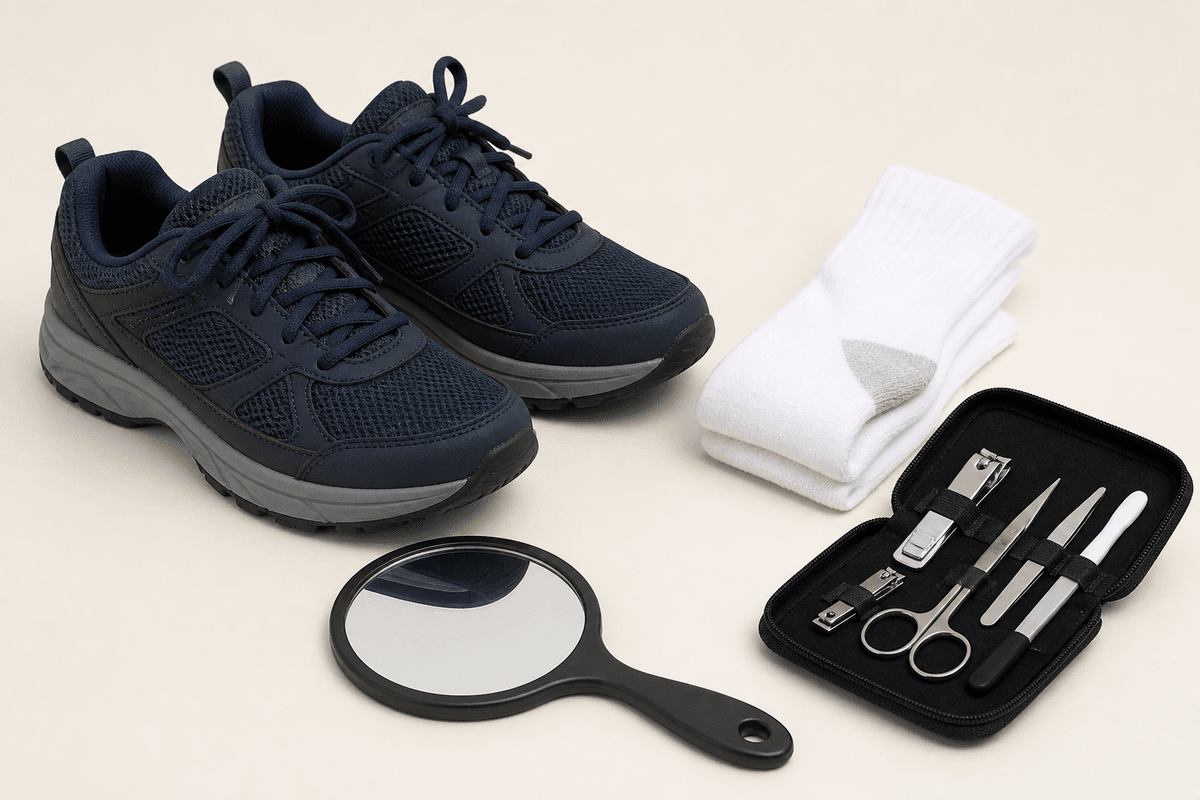
Bathing water should be warm, not hot, on thin older skin and on insensate feet. Pat dry, especially skin folds. Lotion on dry shins is fine; lotion between toes stays wet and grows fungus. Pressure-injury offloading still applies in the chair and the tub: a long soak on the sacrum is still a pressure clock. Full diabetes sick-day and hypo maps live in Diabetes and glycemic emergencies; this chapter owns the feet and the bath.
Priority map
| Picture | First move |
|---|---|
| Intact non-blanchable sacral red | Stage 1; offload, don’t massage |
| Full-thickness with fat only | Stage 3 |
| Maroon boggy intact skin | Deep tissue injury pathway |
| Base covered with eschar/slough | Unstageable; describe what you see |
| Immobile client | Turn, offload heels, dry skin, lift don’t drag |
| Wound with pus + fever | Report infection signs |
| Numb feet + thick nails | Podiatry; closed shoes; no soaking |
Revision
Must know
- 1Stage 1: intact skin, non-blanchable erythema over a bony prominence.
- 2Stage 2: partial-thickness; shallow open ulcer or blister (no slough as the base story).
- 3Stage 3: full-thickness to subcutaneous fat; no bone/tendon/muscle exposed.
- 4Stage 4: exposed bone, tendon, or muscle.
- 5Unstageable: base hidden by slough or eschar so depth cannot be seen.
- 6Deep tissue injury: intact skin with persistent non-blanchable deep red/maroon/purple, often boggy or firm compared with adjacent tissue.
- 7Prevention: reposition on a schedule, keep skin clean/dry, offload sacrum/heels, nutrition/hydration, reduce shear when boosting.
- 8Stage 1 care: offload and protect; do not massage reddened bony areas.
- 9Surgical wound infection cues: increasing redness, warmth, purulent drainage, fever, separating edges; report.
- 10Diabetic or PVD feet: inspect daily, closed shoes, no soaking, no self-trimming of thick nails (podiatry). Report new ulcers, draining callus, or sudden color change.
Memory hooks
Intact red that won’t blanche = 1
If the skin is still closed and the redness stays when pressed, think Stage 1.
Fat visible, no bone = 3
Full-thickness with subcutaneous fat but no bone/tendon/muscle is Stage 3.
Don’t rub the red bone
Massaging non-blanchable redness over a bony prominence worsens tissue injury.
On the exam
How it's tested
Stems describe a sacral finding in words and ask the stage, which prevention actions fit Stage 1, or which diabetic foot teaching is safe. Distractors massage the redness, soak neuropathic feet, or let a client with numb toes cut thick nails at home.
More in adult health
All topics- Acute coronary syndromesNCLEX ACS chapter: STEMI reperfusion, nitroglycerin and cath-site priorities, cardiogenic shock, tamponade and endocarditis cues, and valvular stenosis vs regurgitation.Read
- Acute respiratory emergenciesNCLEX airway map: failure cues, PE vs pneumothorax vs obstruction, oxygen and positioning priorities, and when to escalate.Read
- AnemiasNCLEX hematology chapter: iron, B12, and folate deficiency teaching, anemia activity tolerance, and sickle-cell crisis priorities with emergency red flags.Read
- Antimicrobial therapyNCLEX antimicrobial chapter: allergy checks, finishing the course, vancomycin flushing, aminoglycoside toxicity, TB drug teaching, and common topical agents.Read