Adult health
Burns and inhalation injury
NCLEX burn chapter: airway-first inhalation injury, Rule of Nines and Parkland fluid math, burn depth, and early wound priorities.
ClesialReviewed by Sophia Bennett, RN
Contents9 sections
Burn items are airway first, then volume. If the fire was in a closed space, assume the airway may swell before the skin chart is finished. Chronic pressure-injury staging and surgical wound infection cues live in Wound and pressure injury care. This chapter owns acute burn and inhalation priorities.
Inhalation injury: do not get distracted by the skin
Smoke and heat injure the airway from the inside. Mucosal edema builds over minutes to hours, so a client who still talks on arrival can lose the airway later. Facial or neck burns and an enclosed-space fire raise suspicion before the surface-area chart is finished. The percent burned does not buy time if the voice is changing.
| Cue | Why it matters |
|---|---|
| Facial/neck burns | Edema can obstruct quickly |
| Singed nasal hair / soot in airway | Smoke inhalation likely |
| Hoarseness, stridor, noisy breathing | Airway compromise now |
| Enclosed-space fire history | Raise suspicion even before late signs |
Singed nasal hair and soot mean the smoke path went through the nose and mouth. Hoarseness, stridor, and noisy breathing mean the airway is already narrowing. On the exam those cues beat a dressing plan: support oxygen, ready suction, and escalate for airway protection before you start a full burn dressing change.
The distractor that looks productive is photographing wounds, calculating burn surface area, or lining up ointment while the client is hoarse after a house fire. Surface care matters after the airway is protected. Edge case: facial burns with a still-clear voice still need close airway watching. Late swelling is the trap, not the absence of stridor on minute one.
Safety
Priority with facial burns and a changing voice is airway support and escalation, not starting with a full dressing change.
Initial major burn actions
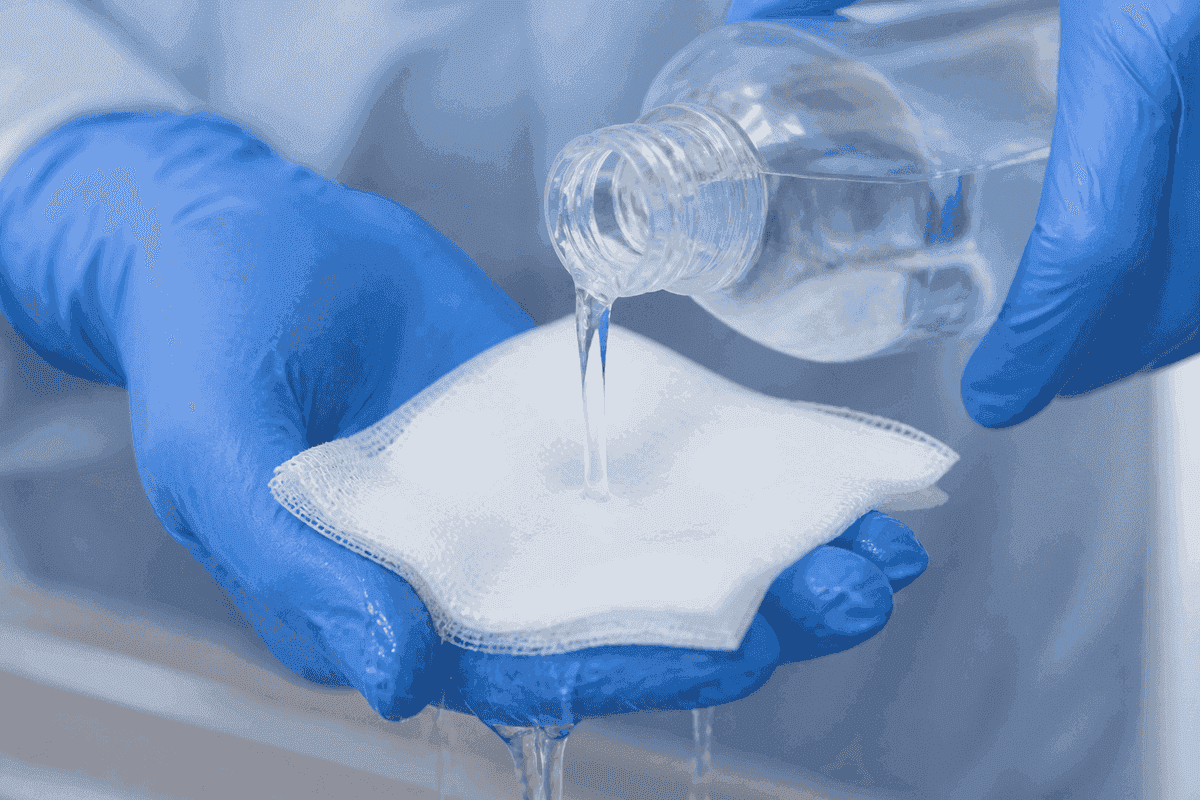
Major burn care is a sequence, not a tray of equal tasks. Stop the burning process so injury does not deepen, then prove airway and breathing before you commit to volume and wound cover. Cool water or saline can limit further heat injury when used briefly. Ice vasoconstricts and deepens tissue damage, so it is wrong for major burns.
- Stop the burning process; move to safety.
- Airway/breathing assessment. Prepare to secure the airway early if inhalation signs exist.
- Large-bore IV access; start ordered fluid resuscitation.
- Cover burns, keep the client warm, treat pain, update tetanus per protocol.
Large-bore IV access and ordered fluid resuscitation replace plasma lost through burned capillary leak. Covering and warming limit heat loss from wet, exposed tissue; hypothermia worsens shock physiology. Pain control and tetanus status belong in early care, not as a reason to skip ABCs.
- Indicated: ABCs, cool briefly, cover, fluids, monitor urine.
- Not indicated: ice packs on major burns, delaying airway for wound photos, oral fluids in shock.
The distractor that looks helpful is packing the burn in ice, butter, or greasy home remedies, delaying airway work for photos, or offering oral fluids to a client in shock. Cool briefly, cover cleanly, give IV fluids as ordered, and watch urine as the volume story. Circumferential burns and tight jewelry raise compartment risk: remove constricting items when safe and watch distal perfusion.
Rule of Nines: estimate %TBSA
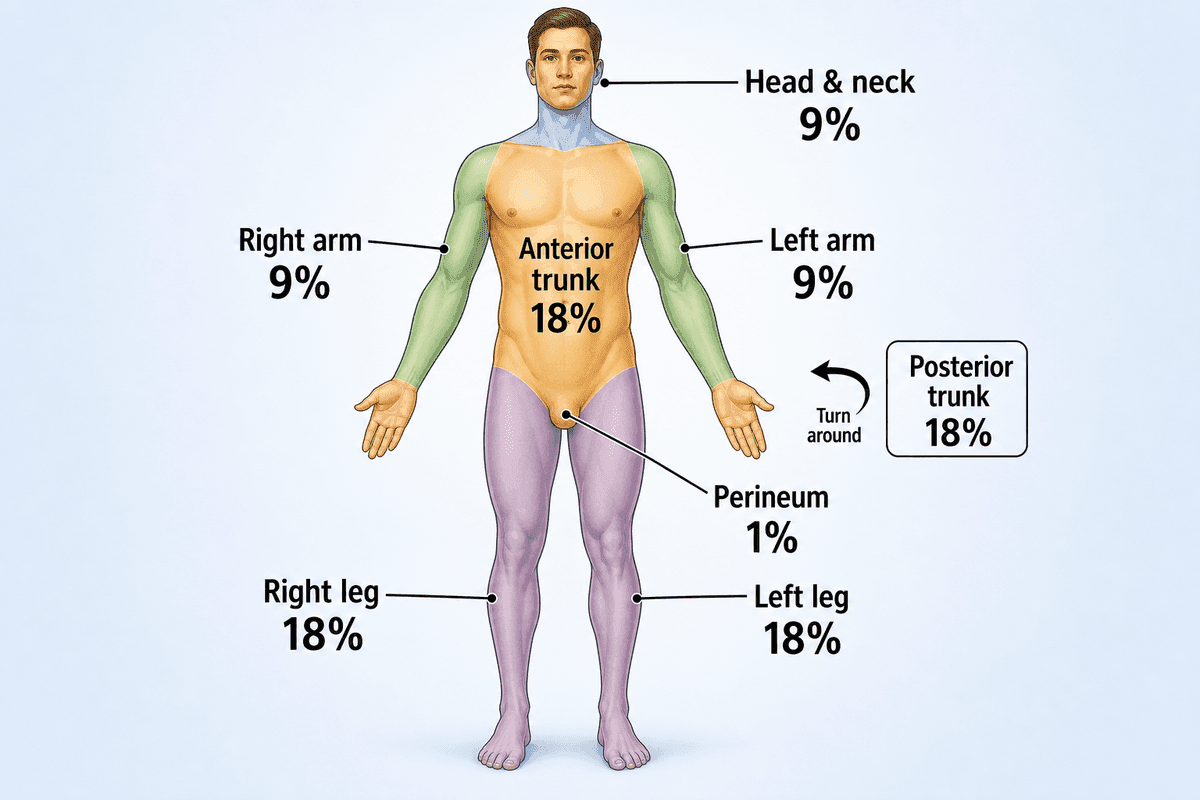
Fluid math and burn-center triage need a quick surface-area estimate. The adult Rule of Nines assigns each major region a percentage that adds to 100%. Count only burned skin the stem describes. Anterior arm is half of that arm’s 9% (4.5%), not a free 9% if the stem says “front of the arm only.”
| Region (adult) | % TBSA |
|---|---|
| Head and neck | 9% |
| Each upper extremity | 9% |
| Anterior trunk | 18% |
| Posterior trunk | 18% |
| Each lower extremity | 18% |
| Perineum / genitalia | 1% |
Why the map exists: capillary leak scales with burned area, so undercounting TBSA underdoses volume and overcounting floods the client. The palm method (client’s palm ≈ 1%) helps scattered or irregular patches when Rule of Nines is clumsy. Pediatric stems often use a modified map because an infant’s head is a larger share. If the stem is a toddler, do not paste adult head/leg numbers without thinking.
The distractor that looks tidy is adding a whole 18% leg when only the anterior thigh is burned, or finishing a TBSA worksheet while the airway is closing. Edge case: first-degree (superficial) areas are sometimes excluded from Parkland TBSA on protocols. Follow what the stem counts as the burn for fluid math.
Parkland formula and depth
Once TBSA and weight are known, the common exam crystalloid plan is Parkland: 4 mL × body weight (kg) × %TBSA = total volume for the first 24 hours. Give half in the first 8 hours, counting from the time of injury, not from the time the ambulance arrived. The remaining half runs over the next 16 hours. Lactated Ringer’s is the fluid most stems name.
Example reasoning (not a number to memorize for every stem): a 70 kg adult with 40% TBSA → 4 × 70 × 40 = 11,200 mL in 24 hours → 5,600 mL in the first 8 hours. If the burn was 2 hours ago, those 5,600 mL must finish in the 6 hours left in that first-8 window. That is why burn time matters.
| Depth | Looks like | Pain / sensation cue |
|---|---|---|
| Superficial | Red, dry, blanches | Painful |
| Partial-thickness | Blisters, moist, red/pink | Very painful |
| Full-thickness | Dry, leathery, white/brown/charred | May be painless where nerves are destroyed |
Depth matters for wound care and prognosis, but it does not outrank airway. Full-thickness and deep circumferential burns raise the escharotomy / compartment conversation when distal pulses, pain out of proportion, or tightness threaten the limb or chest wall. Formulas start the fluid plan; urine output and perfusion tell you if it is working. Protocol mL/kg/hr targets belong to the order set. Do not invent a number if the stem already gives one.
The distractor that looks precise is using arrival time for the 8-hour clock, giving the entire 24-hour volume in eight hours, or chasing a perfect dressing while oliguria and tachycardia say the volume plan failed. Edge case: electrical and inhalation injuries may need more than skin-map math alone. Follow stem cues and ordered pathways.
Carbon monoxide, electrical burns, and wound phases
House-fire clients can carry carbon monoxide even when SpO2 looks oddly reassuring, because many pulse oximeters cannot tell carboxyhemoglobin from oxyhemoglobin. Suspect CO with closed-space smoke exposure, headache, nausea, and cherry-red or nonspecific confusion cues. High-flow oxygen as ordered is the first gas-exchange move while definitive testing proceeds. Do not trust a “normal” SpO2 alone to clear smoke inhalation.
Electrical burns hide deeper injury than the skin spots suggest. Current follows nerves and vessels; watch cardiac rhythm, myoglobinuria/renal risk, and compartment syndrome in the path of the current. Entrance and exit wounds are clues, not the whole injury. Fluid needs may exceed skin-map math. Lightning and high-voltage stems put cardiac monitoring early.
| Phase / issue | Nursing focus |
|---|---|
| Emergent (resuscitative) | Airway, fluids, perfusion, temperature, tetanus |
| Acute (wound) | Infection control, dressing care, nutrition, pain, ROM |
| Rehabilitative | Contracture prevention, psychosocial, scar care teaching |
| Infection watch | Change in wound odor/color, fever, rising WBC. Escalate early |
Burned skin loses its barrier. Sterile or clean technique per protocol, topical antimicrobials as ordered, and nutrition that meets huge metabolic demand (protein and calories) belong after ABCs. Curling’s ulcer risk means stress-ulcer prophylaxis as ordered. Pain control enables dressing changes and breathing exercises. Circumferential chest burns that limit expansion need the same urgency mindset as limb eschar: notify for decompression when ventilation fails.
Priority map
| Picture | First move |
|---|---|
| Soot + hoarse + facial burns | Airway pathway |
| Major burn just arrived | ABCs, access, fluids, cover, warm |
| Stem asks % burned | Rule of Nines / palm. Only regions described |
| Stem asks first-8-hour volume | Parkland → half of 4×kg×%TBSA from burn time |
| Fluids running. Is it enough? | Urine output / perfusion trends |
| Someone reaches for ice | Stop. Cool, don’t freeze |
| Closed-space fire + headache/confusion | CO concern; high-flow O2 as ordered |
| Electrical burn | Cardiac monitor; look past the skin spots |
Revision
Must know
- 1Face/neck burns, singed nasal hair, soot in mouth/nose, hoarseness, stridor, or worsening noisy breathing = inhalation injury → airway first.
- 2Adult Rule of Nines: head/neck 9%, each arm 9%, anterior trunk 18%, posterior trunk 18%, each leg 18%, perineum 1%. Infants have a larger head share. Do not force adult numbers onto a baby stem.
- 3Parkland (common exam form): 4 mL × kg × %TBSA = 24-hour crystalloid; give half in the first 8 hours from time of injury, rest over the next 16. Lactated Ringer’s is the usual fluid named on stems.
- 4Urine output / perfusion tell you if the fluid plan is working. Formulas set the start, not the finish.
- 5Depth: superficial (painful, red), partial-thickness (blisters, very painful), full-thickness (leathery/dry, may be painless where nerves are destroyed).
- 6Do not apply ice, butter, or greasy home remedies to major burns. Circumferential burns: remove constricting items; watch compartment risk / escharotomy path.
Memory hooks
Soot and stridor steal the airway
House-fire facial burns with soot and a hoarse voice are an airway emergency before the dressing tray.
Urine tells the fluid story
After major burn resuscitation, urine output is the practical sign the volume plan is working.
4 × kg × %TBSA
Parkland starts the 24-hour crystalloid plan; half in the first 8 hours from burn time, not from arrival.
Cool, don’t freeze
Cool water helps small/early burns. Ice worsens tissue injury.
On the exam
How it's tested
Stems put soot and hoarseness first, ask for TBSA with Rule of Nines, calculate a Parkland first-8-hour volume, or ask which finding shows fluids are working. Distractors ice the burn, prioritize a dressing over stridor, use admission time instead of burn time, or treat pain score as the fluid endpoint.
More in adult health
All topics- Acute coronary syndromesNCLEX ACS chapter: STEMI reperfusion, nitroglycerin and cath-site priorities, cardiogenic shock, tamponade and endocarditis cues, and valvular stenosis vs regurgitation.Read
- Acute respiratory emergenciesNCLEX airway map: failure cues, PE vs pneumothorax vs obstruction, oxygen and positioning priorities, and when to escalate.Read
- AnemiasNCLEX hematology chapter: iron, B12, and folate deficiency teaching, anemia activity tolerance, and sickle-cell crisis priorities with emergency red flags.Read
- Antimicrobial therapyNCLEX antimicrobial chapter: allergy checks, finishing the course, vancomycin flushing, aminoglycoside toxicity, TB drug teaching, and common topical agents.Read