Adult health
Chest tubes and oxygen delivery devices
NCLEX device map: chest-tube chambers (collection, water seal, suction), tidaling vs leaks, and oxygen devices from cannula to non-rebreather and Venturi.
ClesialReviewed by Sophia Bennett, RN
Contents6 sections
Device items ask whether you understand the plumbing. Tension pneumothorax recognition lives in Acute respiratory emergencies. Chronic COPD oxygen targets live in Respiratory chronic disease. This chapter owns chest-drainage chambers and oxygen delivery hardware.
Chest tube drainage: three chambers
A chest tube pulls air or fluid out of the pleural space so the lung can re-expand. The drainage unit is a one-way system: stuff leaves the chest and should not go back. Knowing which chamber is talking keeps you from treating a normal finding like an emergency — or missing a real leak.
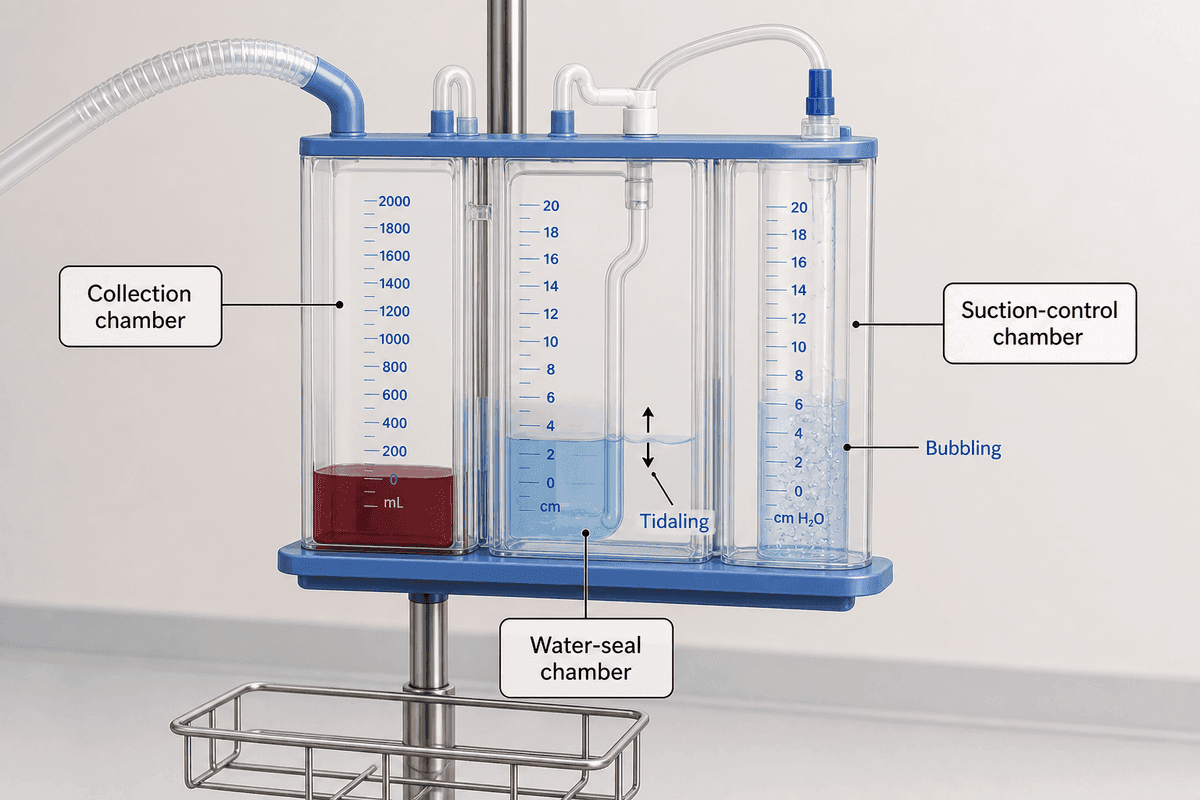
| Chamber | Job | What you expect |
|---|---|---|
| Collection | Holds drainage | Measure and mark output; sudden flood or stop → assess client and tube |
| Water seal | One-way valve | Tidaling with breaths; continuous bubbling → air leak until proven otherwise |
| Suction control | Limits vacuum | Gentle bubbling when suction is on (wet systems); follow dry-system indicators per device |
Tidaling means pressure in the chest is still communicating with the water seal — usually reassuring. Tidaling that stops may mean the lung re-expanded, or the tube kinked/clotted — look at the client before you celebrate. Continuous bubbling in the water seal is different from gentle bubbling in suction control: seal bubbles are the leak hunt; suction bubbles are often how wet suction proves it is working.
- Keep the drainage system upright and below the chest.
- Do not routine-clamp for transport unless protocol says so — clamping can turn a leak into a tension pneumothorax.
- Secure connections; petroleum/occlusive supplies ready per protocol if the tube dislodges.
- Mark drainage at shift change; report sudden floods of bright blood or abrupt stops with distress.
Two emergencies look similar until you name the broken piece. If the drainage tubing disconnects from the unit, a common protocol parks the open chest-tube end briefly in sterile water to recreate a water seal while you rebuild a sterile system — follow facility steps, do not clamp as a first reflex. If the tube pulls out of the chest, cover the site with an occlusive dressing per protocol (often taped on three sides so air can vent), stay with the client, watch for tracheal deviation and crashing SpO2, and get help. New bright-red drainage flooding the collection chamber after chest surgery is a bleed pathway — vital signs and notify beat tidy charting.
Safety
If the chest tube comes out of the chest, follow the emergency occlusive-dressing protocol and assess for tension pneumothorax signs while you get help.
Oxygen delivery devices
Pick the device that matches how much FiO₂ and control the stem needs. Low-flow comfort is not the same as an emergency reservoir mask. Devices do not replace an airway — if the client cannot breathe, escalate beyond a cannula argument.
| Device | Typical use on exams | Trap |
|---|---|---|
| Nasal cannula | Low-flow O₂, talking/eating possible | Ignoring rising O₂ need — escalate device when hypoxic |
| Simple face mask | Moderate FiO₂ when cannula is not enough | Running too low a flow (CO₂ rebreathing risk on some masks) |
| Venturi mask | Controlled FiO₂ (COPD stems that need a precise percent) | Swapping for an uncontrolled high-flow setup when the order wants precision |
| Non-rebreather | High FiO₂ emergencies; reservoir must stay inflated | Deflated bag or side ports open wrong — FiO₂ collapses |
| CPAP / BiPAP (as tested) | Support ventilation in selected failure pictures | Using noninvasive support when the airway is unprotected / vomiting risk |
Why Venturi exists: some clients need a known FiO₂ so you do not overshoot into CO₂ retention territory while still treating hypoxia. Color-coded adapters set the percent — match the order, keep the ports clear, and do not “turn it up like a cannula” when the stem wants precision. Why the non-rebreather bag must inflate: the reservoir is the oxygen stockpile; set flow high enough (often 10–15 L/min as taught) so the bag stays inflated and the mask seals. A flat bag means the client is mostly rebreathing room-leaning gas.
Hypoxic COPD clients still get oxygen — titrate to the ordered saturation band rather than withholding O₂ from fear. The distractor that looks ‘COPD-safe’ is leaving SpO₂ at 78% because ‘they’re retainers.’ Edge case: facial trauma or claustrophobia may block a mask seal — choose an alternative that still delivers ordered oxygen while you escalate. Noninvasive ventilation (CPAP/BiPAP) supports selected failure pictures only when the airway is protected and vomiting risk is managed — it is not a substitute for intubation when the client is crashing and aspirating.
Priority map
| Picture | First move |
|---|---|
| Continuous water-seal bubbles | Assess client; hunt air leak |
| No tidaling | Check kinks/clots and the client’s breath sounds |
| Tube pulled out of chest | Emergency dressing protocol + ABCs |
| SpO₂ crashing | Escalate O₂ device / airway support — don’t debate |
| Ordered precise FiO₂ in COPD | Venturi (or ordered controlled device) |
Revision
Must know
- 1Chest drainage system: collection chamber (output), water-seal chamber (one-way valve — tidaling expected), suction-control chamber (gentle bubbling if suction applied).
- 2Continuous bubbling in the water seal suggests an air leak — find the leak; do not tape blindly over a problem you have not assessed.
- 3Keep the unit below chest level; do not clamp routinely; do not tip or strip aggressively as a habit.
- 4Tube disconnection / system break: sterile water / protocol for open tube end; occlusive dressing strategy if the chest tube itself is pulled — follow the ordered emergency steps.
- 5Nasal cannula ≈ low-flow comfort O₂; simple/Venturi for controlled FiO₂; non-rebreather with inflated reservoir for high FiO₂ emergencies.
- 6Hypoxic clients still get oxygen — including many with COPD history; titrate to ordered targets rather than ‘never give O₂.’
Memory hooks
Tidaling is life in the seal
Water-seal level moving with respiration usually means the system is patent; sudden stop can mean kink, clot, or re-expansion — assess the client.
Bubble continuous in seal = leak hunt
Gentle suction-control bubbles can be normal; continuous water-seal bubbles are the leak alarm.
Reservoir up on the NRB
A non-rebreather only delivers high FiO₂ if the bag stays inflated and the mask seals.
On the exam
How it's tested
Stems ask what continuous water-seal bubbling means, where the unit should sit, or which oxygen device matches a hypoxia picture. Distractors clamp for every problem, milk the tube hard, or withhold O₂ from a hypoxic COPD client.
More in adult health
All topics- Acute coronary syndromesNCLEX ACS chapter: STEMI reperfusion, nitroglycerin and cath-site priorities, cardiogenic shock, tamponade and endocarditis cues, and valvular stenosis vs regurgitation.Read
- Acute respiratory emergenciesNCLEX airway map: failure cues, PE vs pneumothorax vs obstruction, oxygen and positioning priorities, and when to escalate.Read
- AnemiasNCLEX hematology chapter: iron, B12, and folate deficiency teaching, anemia activity tolerance, and sickle-cell crisis priorities with emergency red flags.Read
- Antimicrobial therapyNCLEX antimicrobial chapter: allergy checks, finishing the course, vancomycin flushing, aminoglycoside toxicity, TB drug teaching, and common topical agents.Read