Maternity and newborn
STI and reproductive care
NCLEX reproductive chapter: STI and PID patterns, contraception ACHES danger signs, infertility workup of both partners, endometriosis, BPH/TURP/CBI safety, and testicular/prostate teaching highs.
ClesialReviewed by Sophia Bennett, RN
Contents11 sections
Reproductive items split into infection and gynecologic patterns that stop reinfection and protect fertility, male obstruction care that keeps a TURP catheter patent, and cancer teaching that sends a young man with a painless lump to evaluation instead of “watch it.” Maternity hemorrhage and labor emergencies stay in their own chapters.
STI recognition and teaching
Sexually transmitted infections spread because many are asymptomatic and because untreated partners return the organism. Exam stems care less about memorizing every organism’s Latin name and more about discharge or ulcer cues, pelvic pain with fever (PID), and the teaching triad: finish treatment, treat partners, abstain until both are cleared as directed.
| Pattern (as tested) | Teaching / action angle |
|---|---|
| Chlamydia / gonorrhea | Antibiotics; partner treat; retest as ordered; risk of PID if ignored |
| Syphilis stages | Penicillin pathway as ordered; reportable; partner follow-up |
| HSV outbreaks | Antivirals as ordered; condoms reduce but do not erase shedding risk |
| HPV / warts | Vaccine prevention talk; wart therapy is not the same as removing all cancer-risk teaching |
| Trichomoniasis | Treat partners; avoid alcohol with metronidazole as commonly taught |
| HIV / hepatitis B exposure patterns | Prevention, vaccination where relevant, and public-health follow-up as ordered |
Why partner treatment is non-negotiable: the treated client goes home to the same untreated partner and walks back in with the same organism. That is reinfection, not antibiotic failure. Confidential counseling still allows legally required reporting of named diseases; privacy does not cancel the health-department duty. Condoms and vaccination (HPV, hepatitis B where relevant) are prevention, not optional footnotes. Pregnancy plus STI stems escalate to obstetric pathways: treat infection and protect the fetus as ordered.
- Viral STIs (HSV, HPV, HIV) are managed, not “cured by one cream” promises.
- Reportable diseases follow public-health rules; see rights/reporting chapters for mechanics.
- Discharge teaching fails if it skips abstinence timing or partner therapy.
PID and endometriosis patterns
Pelvic inflammatory disease is ascending infection (often after untreated gonorrhea or chlamydia) that can scar tubes and ovaries. Lower abdominal or pelvic pain, fever, and cervical motion tenderness patterns need prompt evaluation. Do not send the client home with “period cramps” reassurance when the stem screams infection. Abscess, chronic pain, and infertility are the long game the exam expects you to prevent with early treatment.
Safety
Severe pelvic pain with fever after untreated STI risk: think PID / abscess. Escalate; do not delay for “one more day of home rest.”
| Pattern | What it is | Nursing angle |
|---|---|---|
| PID | Ascending genital tract infection | Pain + fever + tender exam cues → escalate; antibiotics as ordered; partner treatment for the STI source |
| Endometriosis | Endometrial-like tissue outside the uterus that bleeds/inflames with the cycle | Cyclic pelvic pain, deep dyspareunia, heavy or painful menses, infertility history → validate pain, support ordered therapy, do not dismiss as drama |
Endometriosis pain is real tissue responding to hormonal cycles outside the uterine cavity. That is why NSAIDs, hormonal suppression, and surgical pathways appear as ordered, and why “tough it out, periods hurt” is the wrong teaching tone. PID is infectious urgency; endometriosis is chronic inflammatory disease that still deserves a workup when function and fertility are on the line. Both can present with pelvic pain, so read the stem for fever and STI risk (PID) versus cyclic chronic pattern (endometriosis).
Contraception danger signs (ACHES)
Combined estrogen-progestin contraception raises clotting tendency. Teaching is not only “take it at the same time daily.” Clients must know which symptoms mean stop the method and seek care. Labor-monitor detail lives in Labour and fetal monitoring; the reproductive danger-sign map belongs here.
| ACHES letter | Symptom cluster | Why it matters |
|---|---|---|
| A | Severe Abdominal pain | Liver, gallbladder, or clot pathway concern |
| C | Chest pain or shortness of breath | PE or cardiac concern |
| H | Severe Headache | Stroke / hypertension concern |
| E | Eye changes (vision loss, blurring) | Retinal / vascular concern |
| S | Severe leg pain or swelling | DVT concern |
The distractor normalizes ACHES as “expected early side effects while your body adjusts.” Mild nausea or breakthrough spotting can be early adjustment; ACHES are vascular emergencies until proven otherwise. Age 35 and older plus smoking is a classic reason to avoid combined hormonal methods because clot risk stacks. Missed-pill rules and backup contraception follow the product teaching on the stem; do not invent a personal schedule. IUDs and progestin-only methods have different warning sets (severe pain after insertion, missing strings, pregnancy symptoms); read the method named in the question.
- Stop combined hormones and seek care for ACHES; do not finish the pack “to stay protected.”
- Teach backup contraception when antibiotics or vomiting affect absorption if the stem flags that product rule.
- Emergency contraception is time-sensitive teaching, not a lecture on judgment.
BPH: obstruction picture
Benign prostatic hyperplasia squeezes the urethra as the gland enlarges. The client reports hesitancy, weak stream, dribbling, incomplete emptying, and nocturia. Stagnant urine invites UTI and acute retention. A painful full bladder that will not empty is an emergency catheterization pathway as ordered, not a “drink more tea” tip.
Nursing teaching before surgery focuses on timed voiding, reducing evening fluids if ordered, avoiding OTC anticholinergics that worsen retention when the stem flags them, and reporting fever, back pain, or inability to void. Alpha-adrenergic blockers relax prostate smooth muscle but can cause orthostatic hypotension. First-dose bedtime teaching and slow position changes appear often. 5-alpha-reductase inhibitors shrink tissue over months; teach that benefit is slow and that pregnant people should not handle crushed tablets when that warning is on the stem.
- Assess retention: bladder scan / post-void residual as protocol allows.
- Treat infection cues promptly. Fever with obstructive symptoms is not “just BPH.”
- Prepare for TURP teaching when medical management fails on the stem.
TURP and continuous bladder irrigation
Transurethral resection of the prostate removes obstructing tissue through the urethra. Continuous bladder irrigation (CBI) flushes blood clots so the three-way catheter stays open. Expect pink-tinged urine that gradually clears. Bright red drainage with clots, sudden abdominal pain, or a dry drainage bag with a tense bladder means obstruction or arterial bleeding. Notify, hand-irrigate only as protocol allows, and never ignore a clamped-feeling system.
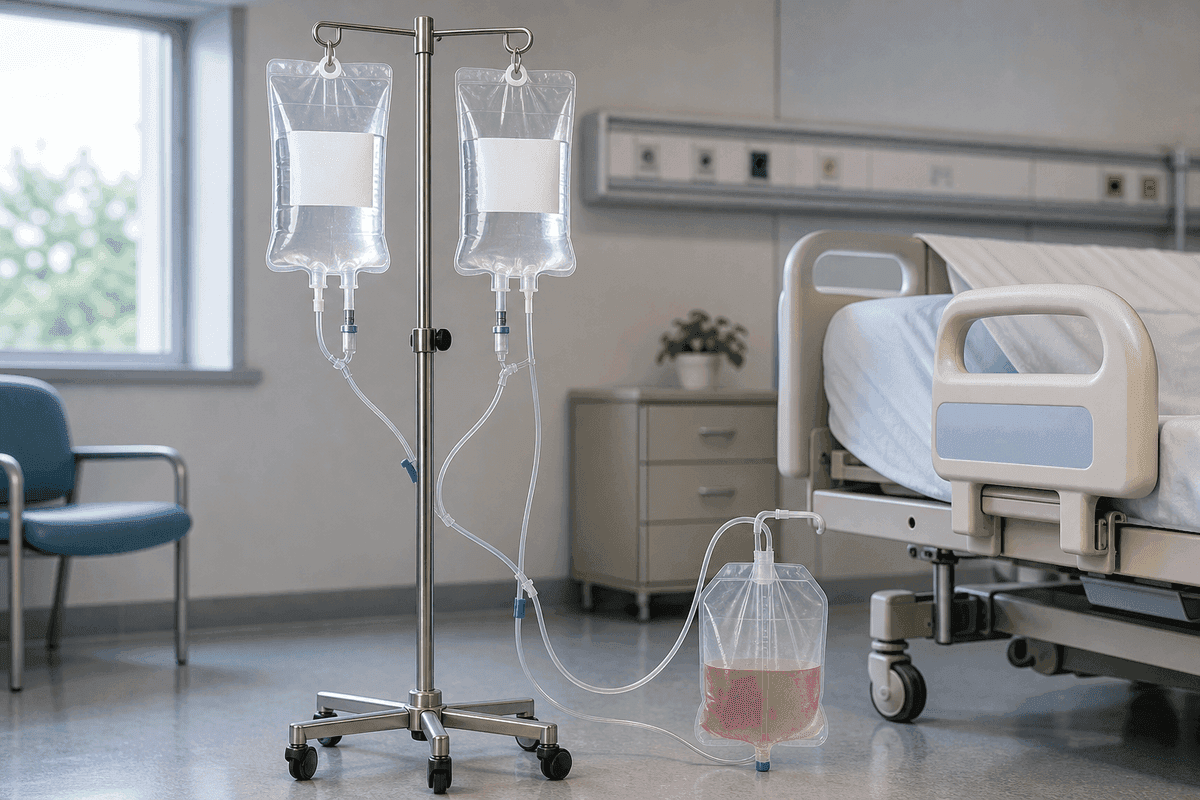
| Finding | Meaning | Action |
|---|---|---|
| Pink → clearer over hours | Expected postop | Maintain CBI; titrate per order |
| Bright red + clots | Active bleed / obstruction risk | Notify; follow irrigation protocol |
| No output + distended bladder | Catheter blocked | Emergency patency pathway |
| Hyponatremia / confusion (TURP syndrome pattern) | Absorption of irrigant | Stop irrigation per protocol; notify now |
Why CBI exists: resected tissue bleeds into a closed bladder; clots act like a cork. Irrigation keeps flow moving so bladder pressure does not skyrocket. TURP syndrome is systemic absorption of hypotonic irrigant that dilutes sodium and muddies mental status. That is why confusion plus falling sodium on irrigation is an emergency stop-and-notify pattern, not “give him a nap.” After the catheter comes out, temporary dribbling is common. Teach Kegels as ordered and protect skin. No heavy lifting, straining, or prolonged sitting on a hard surface as directed; stool softeners prevent bearing-down bleeds. Sexual function questions go to honest counseling with the provider. Do not invent guarantees.
Testicular and prostate teaching highs
Testicular cancer teaching targets adolescents and young adults: a painless lump, heaviness, or change in size needs prompt evaluation, not months of hoping it is a strain. Monthly self-exam after a warm shower (when the scrotum is relaxed) is the classic teaching pattern when the stem asks prevention awareness. Cryptorchidism history raises risk. Fertility and sperm-banking conversations belong before treatments that threaten fertility when the stem goes there.
| Topic | High-yield teaching |
|---|---|
| Testicular self-exam | Warm shower; roll each testis; report hard lump, swelling, or heaviness |
| Testicular cancer age pattern | Younger men; painless mass is a red flag, not reassurance |
| Prostate cancer screening talk | Shared decision on PSA/DRE timing with the provider; not the same as BPH symptom care |
| BPH vs cancer | BPH is obstruction symptoms; cancer may be silent early. Do not tell clients BPH “becomes” cancer as a rule |
| Post-prostatectomy / radiation themes (as tested) | Incontinence and erectile change are honest counseling topics; catheter and infection teaching as ordered |
Prostate conversations on the exam often mix BPH obstruction with cancer screening. Keep them separate: alpha-blockers and TURP address blockage; PSA and digital exam discussions are screening decisions with the provider. The distractor that harms is reassuring a young man that a hard testicular lump is “probably nothing” because it does not hurt.
Infertility: test both, start with the simpler sample
Infertility on the exam is usually inability to conceive after about a year of unprotected intercourse (sooner if the stem already flags age or known pelvic disease). PID scarring, endometriosis, anovulation, and male factor all appear. Work up both partners. A semen analysis is often the first male test because it is less invasive than jumping to laparoscopy. Female testing (ovulation, tubes, uterus) follows the obstetric plan. Teach the fertile window rather than daily intercourse that exhausts the couple, smoking and heavy alcohol as fertility hits, and that clomiphene or other ordered agents need timed intercourse and ovarian-hyperstimulation warning as taught. Emotional distress is expected; do not treat the couple as “impatient” at month three of a year-long definition. Fetal circulation anatomy lives in Prenatal care; contraception ACHES stays in this chapter and in Labour and fetal monitoring.
Priority map
| Situation | First move |
|---|---|
| STI treatment teaching | Partners + finish meds + abstain until cleared |
| Pelvic pain + fever (PID risk) | Escalate; do not minimize |
| ACHES on combined hormones | Stop method; urgent evaluation |
| Acute urinary retention (BPH) | Bladder relief pathway as ordered |
| TURP: no drainage + tense belly | Patency / notify emergency |
| TURP: ketchup-red clots | Bleed pathway; notify |
| Painless testicular lump | Prompt evaluation, not watchful waiting at home |
| Infertility, only the woman tested so far | Include semen analysis / male factor |
Revision
Must know
- 1STI teaching always includes treat partners, abstain until cleared as directed, and finish antibiotics. Silent partners reinfect.
- 2PID: pelvic pain, fever, cervical motion tenderness patterns. Escalate; untreated infection risks infertility and abscess.
- 3Combined hormonal contraception: ACHES (Abdominal pain, Chest pain, severe Headache, Eye changes, Severe leg pain) means stop and seek care. Smoking + age 35+ raises clot risk with estrogen.
- 4Endometriosis: cyclic pelvic pain, dysmenorrhea, sometimes infertility. Support pain control and follow-up; not “just bad periods” forever.
- 5BPH: hesitancy, weak stream, nocturia, retention risk. Watch for infection and post-void residual problems.
- 6TURP: continuous bladder irrigation keeps urine pink-tinged progressing to clear; bright red with clots or sudden stop of outflow is emergency.
- 7After TURP: no heavy lifting/straining as ordered; expect temporary incontinence teaching and catheter care. Alpha-blockers can drop BP.
- 8Testicular cancer teaching: monthly self-exam pattern as taught, painless lump/heaviness needs evaluation, peak young adult risk. Prostate screening and BPH are different conversations.
- 9Infertility: both partners. Semen analysis is often first because it is less invasive. Teach timing (ovulation window), stop smoking/alcohol as taught, and that one normal month does not close the workup.
Memory hooks
Treat the pair
STI stems almost always need partner treatment and abstinence until both are cleared.
ACHES means stop the pill
Severe Abdominal pain, Chest pain, Headache, Eye changes, Severe leg pain: stop combined hormones and get care.
Pink to clear, not ketchup
TURP irrigation should lighten. Bright red clotty output or no output means act now.
On the exam
How it's tested
Stems ask what to teach after chlamydia treatment, when PID needs escalation, what ACHES means, why CBI slows, or what a painless testicular lump needs. Distractors skip partner therapy, reassure ACHES as “adjustment,” clamp irrigation for “rest,” or promise viral STIs are permanently gone after one course.
More in maternity and newborn
All topics- Labour and fetal monitoringNCLEX labor chapter: stages and 4 Ps, Leopold maneuvers, FHR patterns, oxytocin tachysystole, epidural hypotension and high-block red flags, shoulder dystocia and rupture, plus ACHES warnings.Read
- Maternity and newborn medicationsNCLEX maternity meds: vitamin K and eye prophylaxis, RhoGAM, oxytocin tachysystole, methylergonovine hold rules, magnesium toxicity, and betamethasone for lungs.Read
- Maternity emergenciesNCLEX maternity emergencies: preeclampsia/HELLP and magnesium toxicity, ectopic and mole, cerclage, abruption vs previa, PPH, cord prolapse, TORCH/GDM crises, cardiac disease with postpartum autotransfusion, and tachysystole.Read
- Newborn metabolic and respiratory complicationsNCLEX newborn chapter: IDM hypoglycemia, hypothermia, TTN vs RDS vs meconium, phototherapy, PKU/hypothyroid screens, plus NEC, ROP, IVH, NAS/FASD, and SGA/LGA risk.Read