Maternity and newborn
Prenatal care
NCLEX prenatal chapter: Naegele and GTPAL, danger signs, GDM screening and teaching, TORCH exposures, NST/BPP/fibronectin testing, and fetal circulation shunts that close after birth.
ClesialReviewed by Sophia Bennett, RN
Contents9 sections
Prenatal items test calendar math, which signs truly prove pregnancy, which symptoms mean the client should not wait for the next scheduled visit, and how gestational diabetes, TORCH exposures, and antepartum tests change the plan.
Assessment and history tools
Prenatal assessment is a map of dates, prior outcomes, and what actually proves pregnancy. Wrong calendar math misplaces gestational age. Wrong GTPAL counting muddies risk. Calling a presumptive symptom a “positive sign” is a classic distractor.
| Tool | Use |
|---|---|
| Naegele’s rule | Estimate EDD from LMP |
| GTPAL | Summarize obstetric history |
| Positive signs | FHT, ultrasound, examiner-felt movement |
| RhoGAM planning | Rh-negative protocols |
Naegele’s rule estimates the due date from the first day of the last menstrual period: subtract 3 months, add 7 days, and add a year when the calendar needs it. It is an estimate for a regular 28-day cycle; irregular cycles or uncertain LMP need ultrasound dating, but the exam still expects the arithmetic when an LMP is given.
GTPAL packs obstetric history into one string: Gravida (pregnancies), Term births, Preterm births, Abortions (spontaneous or elective before viability), Living children. Count each pregnancy once under Gravida; twins still count as one pregnancy but two living children if both survive. Miscounts usually come from treating twins as two gravidas or forgetting a miscarriage under Abortions.
Positive signs prove a fetus: fetal heart tones, ultrasound visualization, or fetal movement felt by the examiner. Amenorrhea, nausea, breast changes, and a positive home urine test are useful clues; they are not positive signs. The distractor looks right because those symptoms often mean pregnancy; the exam asks which finding is definitive, not which is common.
RhoGAM planning belongs in the history for Rh-negative clients so sensitization is prevented before antibodies form. Typical windows already in protocol teaching include mid-pregnancy dosing, after sensitizing events, and postpartum when the infant is Rh-positive. Drug timing detail lives with Maternity and newborn medications; here the job is knowing Rh status drives that pathway.
Danger signs and position
Most prenatal visits are routine. Danger signs mean the pregnancy may be bleeding, ischemic, infected, or in preterm labor; same-day evaluation, not “mention it next week.” Mechanism and position matter: a gravid uterus can crush venous return when the client lies flat.

| Danger sign | Why it is urgent | First teaching / action |
|---|---|---|
| Vaginal bleeding | Previa, abruption, or threatened loss until proven otherwise | Same-day / emergency evaluation; no vaginal exam if previa suspected |
| Severe headache, visual spots, epigastric/RUQ pain | Preeclampsia end-organ risk | Escalate on preeclampsia pathway; not “normal pregnancy ache” |
| Fluid gush or trickle | ROM until evaluated | Go in; note time, color, odor |
| Regular preterm contraction pattern | Cervical change risk before 37 weeks | Labor/PTL workup; not Braxton Hicks by default |
| Fever with dysuria / flank pain | Ascending UTI / pyelo risk in pregnancy | Evaluate and treat; infection can trigger PTL |
| Marked drop or absent fetal movement | Possible fetal compromise | Same-day evaluation (often NST pathway) |
- Report bleeding, severe headache, visual changes, epigastric pain, fluid leak, fever with dysuria, regular preterm contractions.
- Dizziness flat on the back: turn to the left side immediately.
Full emergency sequencing for preeclampsia, previa, and abruption is in Maternity emergencies. Preterm labor detail sits in Preterm labor. Here the job is recognizing which comfort complaint is actually a ticket to triage.
Supine hypotensive syndrome: late in pregnancy the heavy uterus compresses the inferior vena cava when the client lies flat. Venous return falls, cardiac output drops, and the client feels dizzy, nauseated, or pale; and fetal perfusion can dip with maternal output. Turning left lateral rolls the uterus off the cava and restores flow within moments. The distractor sits the client bolt upright or keeps them supine for “better fetal monitoring” while ignoring the dizziness; fix position first.
Safety
No fetal movement since yesterday is a same-day evaluation, not a “drink juice and wait until tomorrow” plan when movement has truly stopped.
Fetal movement is a crude but useful vitality check. A true stop or marked drop from the client’s usual pattern needs same-day assessment (often a nonstress test or similar pathway). “Drink juice and wait overnight” is the trap when movement has already ceased; that delay is what the item is testing.
Comfort, nutrition, fetal movement
Comfort and nutrition teaching keeps the pregnancy safer, not just more comfortable. Folate timing matters because the neural tube closes early. Iron supports expanding maternal blood volume. Movement teaching gives the client a clear trigger to call instead of waiting for the next appointment.
| Topic | Teaching point | Why |
|---|---|---|
| Folic acid | Start before conception when possible; continue early pregnancy | Neural tube closes in embryonic weeks; late start misses the window |
| Iron / prenatal vitamin | Take as taught; pair strategies for nausea (food, evening dose) | Maternal blood volume expands; skipping vitamins is not a fix for nausea |
| Mild nausea | Small frequent meals; bland carbs; avoid long empty-stomach gaps | Empty stomach and strong smells worsen first-trimester nausea for many |
| Hyperemesis pattern | Persistent vomiting, weight loss, dehydration → report now | Not “tough-it-out” first-trimester nausea |
| Kick counts (3rd trimester) | Know baseline; call for drop or absent movement same day | Movement is a fetal vitality signal parents can track |
- Take prenatal vitamins / folic acid as taught.
- Manage nausea with small frequent meals as advised; report hyperemesis patterns.
- Teach kick counts / movement awareness in the third trimester per protocol.
- Avoid alcohol; discuss medications and supplements with the prenatal team before taking them.
Folic acid before conception and early pregnancy lowers neural tube defect risk because closure happens in the embryonic weeks; waiting until a positive test to start is later than ideal. Prenatal vitamins package folate with iron and other micronutrients; teach adherence and what to do if tablets trigger nausea (timing with food, evening dose as advised), not skipping the vitamin entirely.
Mild nausea often settles with small frequent meals, bland carbs, and avoiding empty-stomach long gaps. Hyperemesis; persistent vomiting with weight loss, dehydration, or inability to keep fluids; is a report-now pattern, not tough-it-out advice. The distractor treats relentless vomiting as normal first-trimester nausea.
In the third trimester, teach the facility’s kick-count or fetal-movement awareness method so the client knows her baseline. Count in a quiet period when the fetus is usually active; a drop below the taught threshold or a day of absent movement triggers the same-day call. Exact count thresholds follow protocol; what the exam rewards is recognizing reduced movement as urgent and knowing the client should not wait for the next scheduled visit.
Common discomfort teaching that still appears: left-side rest for vena cava relief, support hose and leg elevation for dependent edema that is mild and expected, and reporting facial/hand swelling with headache rather than dismissing all edema. The edge case is treating facial edema plus visual changes as “third-trimester puffiness.”
Gestational diabetes, TORCH, and antepartum tests
Not every prenatal stem is calendar math. Mid-pregnancy glucose screening, infection exposures that reach the fetus, and bedside tests of fetal well-being are the other high-yield map. Hypertensive crises, mole, and cerclage sequencing live in Maternity emergencies. Newborn hypoglycemia after a diabetic pregnancy lives in Newborn metabolic and respiratory complications.
Gestational diabetes is glucose intolerance first recognized in pregnancy. Placental hormones raise insulin resistance as gestation advances, so screening usually sits in the mid-pregnancy window taught on the exam (often around 24 to 28 weeks; earlier if the stem already flags high risk). A failed challenge test leads to a diagnostic oral glucose tolerance pathway as ordered. First-line teaching is a consistent carbohydrate pattern, glucose self-checks, and activity as cleared. Insulin is added when diet does not keep values in the ordered range; oral agents appear only when the obstetric plan names them. The exam trap is treating GDM as “a little sugar, no big deal” or skipping newborn glucose risk because the mother’s A1c looks fine. Maternal hyperglycemia still drives fetal hyperinsulinism; the infant can crash glucose after the cord is cut.
Intrapartum and sick-day GDM crises (hypoglycemia on insulin, DKA even when the glucose number looks less extreme than in nonpregnant DKA) follow emergency pathways in Maternity emergencies and Diabetes and glycemic emergencies. Here the job is screening, diet-then-insulin teaching, and knowing the newborn is a hypoglycemia risk.
| Topic | What the exam wants | Why it is not optional |
|---|---|---|
| GDM screening | Glucose challenge in the taught window; diagnostic test if that fails | Missed GDM raises macrosomia, birth trauma, and neonatal hypoglycemia risk |
| GDM teaching | Diet and checks first; insulin as ordered; keep appointments | Placental hormones keep raising insulin need; a one-time lecture does not last the trimester |
| Toxoplasmosis | Avoid changing cat litter; cook meat; gloves for garden soil | Parasite crosses the placenta and can injure the developing fetus |
| Rubella | Immunity before pregnancy; no live MMR while pregnant | First-trimester infection is a classic congenital-defect pathway |
| CMV / HSV as tested | Hand hygiene for CMV; report genital lesions; active HSV at labor may mean cesarean as ordered | Viral exposure at the wrong time changes fetal or newborn risk |
TORCH is a cluster, not a single lab: Toxoplasmosis, Other (syphilis, varicella, parvovirus as the stem names them), Rubella, CMV, HSV. The nursing job is exposure teaching and knowing when birth route or isolation changes. Cat litter and undercooked meat are the toxoplasmosis teaching objects. Rubella vaccine is live; give it before pregnancy or postpartum, not during. CMV spreads in body fluids; hand hygiene after diaper changes and avoiding shared cups with toddlers is the practical teach. HSV with active genital lesions at labor is a cesarean conversation as ordered, not “push through a vaginal birth because she is already dilated.” Syphilis and other named infections follow the obstetric and public-health pathway in the stem; do not invent a home remedy.
Antepartum tests ask whether the fetus is oxygenated enough to stay in, or whether preterm labor is likely this week. A nonstress test watches the fetal heart for accelerations with movement. Reactive (the reassuring label) means the strip meets the taught acceleration criteria in the time window; nonreactive is not a diagnosis of death, but it is not “go home and sleep it off” either. Next steps are often extend the test, stimulate as protocol allows, then a biophysical profile. A BPP adds ultrasound pieces (fetal breathing movements, body movement, tone, amniotic fluid) to the NST. Low fluid or a low total score is a notify-and-plan finding, not a coaching-only visit. Fetal fibronectin is a cervical or vaginal swab used in a preterm-labor window: a negative result is the reassuring one against birth in the immediate days that the test is built for. A positive result is not proof that labor has started; it only fails to rule it out. The distractor treats a negative fibronectin as permission to ignore regular contractions, bleeding, or fluid leak.
- GDM: screen, teach diet and checks, add insulin as ordered; plan for neonatal glucose surveillance after birth.
- TORCH: named exposures have named teaching; live rubella vaccine is not a prenatal injection.
- Nonreactive NST: more testing, not discharge-with-juice as the only plan.
- Negative fetal fibronectin reassures against imminent preterm birth in the tested window; it does not cancel other PTL cues. Preterm labor sequencing is in Preterm labor.
Fetal circulation (why the newborn’s heart rewires)
In utero the placenta is the lung. Oxygenated blood returns through the umbilical vein, much of it bypasses the liver through the ductus venosus, and two heart shunts skip the unused lungs: foramen ovale (right atrium to left atrium) and ductus arteriosus (pulmonary artery to aorta). Two umbilical arteries carry waste blood back to the placenta. At the first effective breaths, pulmonary resistance falls, left-sided pressure rises, and those shunts close functionally. Persistent cyanosis after transition is not “fetal circulation still running as designed”; it is a workup. Infertility workup (who to test first) lives in STI and reproductive care.
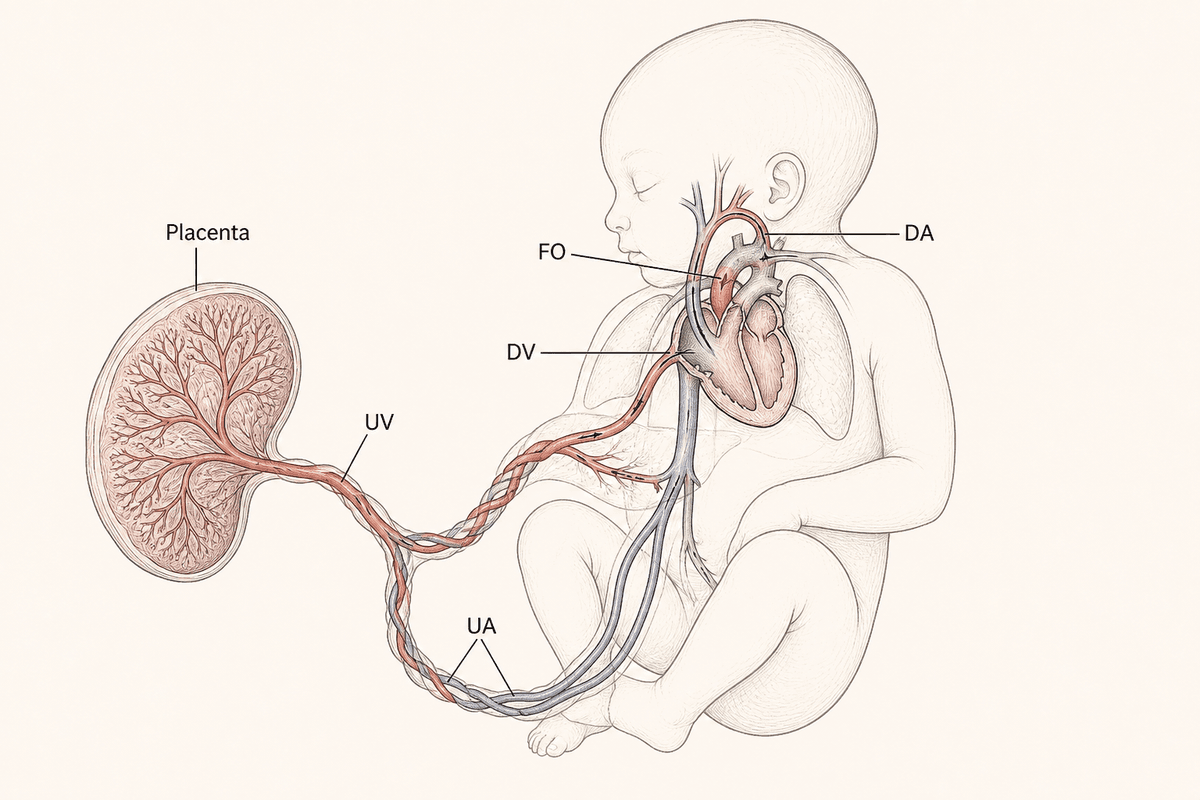
Priority map
| Picture | First move |
|---|---|
| Dizzy flat at 30 weeks | Left lateral |
| No kicks all day | Same-day evaluation |
| Severe headache + spots | Preeclampsia pathway |
| LMP date given | Naegele EDD |
| Failed glucose screen at 26 weeks | Diagnostic GDM pathway; diet teaching |
| Nonreactive NST | Do not discharge on juice alone; extend / BPP as ordered |
| Cat litter + first trimester | Toxoplasmosis teaching; do not change litter |
| Why a newborn can skip the lungs in utero | FO and DA shunts; they should close after birth |
Revision
Must know
- 1Naegele: LMP − 3 months + 7 days (+1 year as needed) for EDD estimate.
- 2GTPAL: Gravida, Term, Preterm, Abortions, Living; count carefully.
- 3Positive pregnancy signs: fetal heart tones, ultrasound visualization, fetal movement felt by examiner; not just amenorrhea/nausea.
- 4RhoGAM situations for Rh-negative clients per protocol (28 weeks, after sensitizing events, postpartum if infant Rh-positive).
- 5Danger signs: vaginal bleeding, severe headache/visual changes, severe epigastric pain, fluid gush, decreased fetal movement, dysuria with fever, preterm contractions pattern.
- 6Supine hypotension: dizzy/nauseated flat on back; turn left lateral.
- 7Folic acid before/early pregnancy reduces neural tube defects.
- 8Decreased fetal movement: same-day evaluation; do not wait overnight if movement has stopped.
- 9GDM: screen in the window taught (often mid-pregnancy); diet and glucose checks first; insulin as ordered. Newborn hypoglycemia risk after birth lives in the newborn complications chapter.
- 10Fetal circulation: UV in, DV past liver, FO and DA past lungs, two UA back to placenta. Birth opens the lungs and those shunts close.
- 11TORCH teaching: toxoplasmosis (cat litter, undercooked meat), rubella immunity before pregnancy (no live vaccine while pregnant), CMV hygiene, HSV active lesions at labor may change birth route as ordered.
- 12NST: reactive means accelerations that meet the taught criteria. BPP adds ultrasound (breathing, movement, tone, fluid) to the NST. Fetal fibronectin: a negative result is the reassuring one against imminent preterm birth in the tested window.
Memory hooks
Bleed, headache, no kicks = call
Bleeding, severe neuro/visual cues, and absent fetal movement are same-day danger signs.
Left side for the vena cava
Supine hypotensive syndrome improves when the gravid uterus rolls off the vena cava.
Folic acid before the tube closes
Start folate before conception when possible; neural tube closure is early.
Reactive NST, scored BPP
A reactive NST shows accelerations. A BPP stacks ultrasound pieces onto that strip. Neither is a reason to ignore a danger-sign story.
On the exam
How it's tested
Stems ask EDD from LMP, which sign is positive, what to do when the client is dizzy flat, no kicks since yesterday, how to teach GDM or TORCH, or what a nonreactive NST means next. Distractors treat amenorrhea as a positive sign, wait overnight on absent movement, or treat a negative fibronectin as a reason to ignore contractions.
More in maternity and newborn
All topics- Labour and fetal monitoringNCLEX labor chapter: stages and 4 Ps, Leopold maneuvers, FHR patterns, oxytocin tachysystole, epidural hypotension and high-block red flags, shoulder dystocia and rupture, plus ACHES warnings.Read
- Maternity and newborn medicationsNCLEX maternity meds: vitamin K and eye prophylaxis, RhoGAM, oxytocin tachysystole, methylergonovine hold rules, magnesium toxicity, and betamethasone for lungs.Read
- Maternity emergenciesNCLEX maternity emergencies: preeclampsia/HELLP and magnesium toxicity, ectopic and mole, cerclage, abruption vs previa, PPH, cord prolapse, TORCH/GDM crises, cardiac disease with postpartum autotransfusion, and tachysystole.Read
- Newborn metabolic and respiratory complicationsNCLEX newborn chapter: IDM hypoglycemia, hypothermia, TTN vs RDS vs meconium, phototherapy, PKU/hypothyroid screens, plus NEC, ROP, IVH, NAS/FASD, and SGA/LGA risk.Read