Maternity and newborn
Labour and fetal monitoring
NCLEX labor chapter: stages and 4 Ps, Leopold maneuvers, FHR patterns, oxytocin tachysystole, epidural hypotension and high-block red flags, shoulder dystocia and rupture, plus ACHES warnings.
ClesialReviewed by Sophia Bennett, RN
Contents9 sections
Labor questions ask whether you can place Leopold hands, name the stage, read the fetal monitor pattern, stop the right drug, and recognize the birth emergencies that need a team in the room now; then teach contraception danger signs without shame. Cord prolapse, previa/abruption sequencing, preeclampsia, and postpartum hemorrhage live in Maternity emergencies; this chapter owns stages and 4 Ps, Leopold, FHR pattern meaning, the birth emergencies in its table, and contraceptive red flags.
Stages, 4 Ps, and Leopold
Labor is a sequence, not a single event. The first stage is cervical dilation and effacement, often split into a slower latent phase and a more intense active phase that ends at complete dilation (about 10 cm as tested). The second stage is pushing through birth of the neonate. The third stage is placental separation and delivery; a gush of blood, cord lengthening, and a rising globular fundus are the usual separation cues. The fourth stage is the first one to two hours after the placenta, when atony and laceration bleeding declare themselves. Calling stage four “recovery, so relax the fundus checks” is the miss; that is when Maternity emergencies hemorrhage rules start.
| Stage | What is happening | Nursing focus as tested |
|---|---|---|
| First (latent → active) | Cervix dilates and thins; contractions organize | Support, hydration, monitor fetus and labor progress; transition (about 8–10 cm) is intense, not a hemorrhage cue by itself |
| Second | Complete dilation to birth | Pushing support, FHR, prepare for shoulder dystocia if the stem turns that way |
| Third | Placenta delivers | Watch for separation signs; do not yank the cord; prepare for atony if the placenta is slow or incomplete |
| Fourth | Immediate postpartum | Fundus, lochia, vitals, bonding; this is a hemorrhage-watch window |
True labor still has to produce cervical change. Regular contractions that get stronger and closer, persist with walking, and move from back to front are the usual fingerprint. Braxton Hicks tighten without progressive dilation. Full true-versus-false comparison also sits in Maternity emergencies; here the job is tying that distinction to stage and to the 4 Ps.
The 4 Ps name why labor stalls or progresses. Powers are uterine contractions (and maternal pushing in stage two): frequency, duration, and intensity have to dilate the cervix and move the passenger. Passage is the bony pelvis and soft tissue. Passenger is the fetus: lie, presentation, attitude, position, and size. Psyche is whether fear, exhaustion, or lack of support is stalling effective pushing. Some stems add Position (maternal) as a fifth P; left-lateral and upright changes can improve perfusion and help the passenger rotate. Failure to progress is not “try harder at the same broken P.” Name which P is failing, then notify for augmentation, rest, position change, or another birth plan as ordered. The strip still outranks the dilation clock.
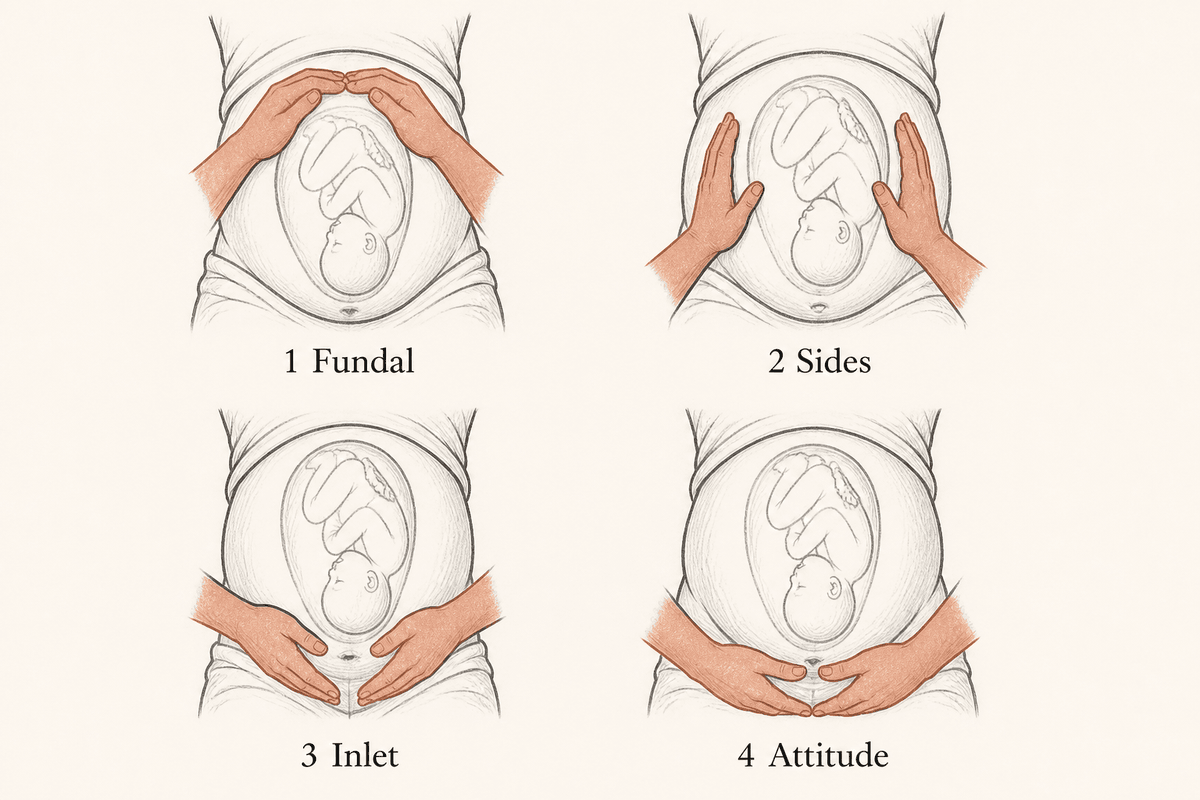
Leopold maneuvers are a four-step abdominal palpation map, not a ritual you skip because the ultrasound already ran. 1 Fundal grip asks what occupies the top of the uterus: a hard round head versus a softer irregular breech. 2 Side grips find the fetal back (smooth and firm, where you want the toco/ultrasound transducer) versus small parts (lumpy). 3 Inlet / Pawlik grip above the pubis asks whether the presenting part is engaged or still ballotable. 4 Attitude (examiner facing the feet) feels whether the head is flexed or extended at the brim. You do this before you guess monitor placement and before you assume vertex just because the bump looks “head down.” Breech or transverse findings change the labor plan; they are not a reason to start oxytocin on a stem that never cleared the lie.
Fetal heart rate patterns
The fetal heart rate is a real-time perfusion and oxygenation report. Term baseline commonly sits near 110-160 beats/min. Accelerations with movement are reassuring. Decelerations are timed against the contraction: same timing as the squeeze, after the peak, or irregular and abrupt. That timing names the usual cause; and whether you watch, reposition, or run intrauterine resuscitation now.
| Pattern | Usual association | Nursing stance |
|---|---|---|
| Early deceleration | Head compression | Often expected in active labor; continue monitoring |
| Variable deceleration | Cord compression | Reposition; amnioinfusion if ordered; assess persistence |
| Late deceleration | Uteroplacental insufficiency | Intrauterine resuscitation; stop oxytocin if running |
| Minimal variability + lates | Fetal compromise risk | Escalate; do not wait for “one more hour” |
VEAL CHOP is the timing map: Variable → Cord; Early → Head; Acceleration → OK; Late → Placental insufficiency. Early decelerations mirror the contraction because the head is compressed in the pelvis; vagal slowing that usually tracks progress. They are not a first-action emergency when the rest of the strip is reassuring. Variable decelerations are abrupt and changeable in shape and timing because the cord is squeezed or kinked; blood flow drops until position or fluid relieves the pressure. Late decelerations begin after the contraction peak and recover late because each squeeze briefly starves the placenta of oxygen delivery; uteroplacental insufficiency until proven otherwise.
| Strip finding | What it usually means | Why you act or watch |
|---|---|---|
| Accelerations with movement | Intact autonomic response | Reassuring when paired with normal baseline |
| Moderate variability | Well-oxygenated fetal CNS | Good sign; absent/minimal with lates is not |
| Tachycardia (baseline high) | Maternal fever, infection, dehydration, or fetal stress patterns as tested | Treat the cause; do not ignore with other nonreassuring cues |
| Bradycardia | Acute insult until proven otherwise | Intrauterine resuscitation / escalate; not “watch one more hour” |
Minimal variability plus recurrent lates means the fetus is struggling to compensate. Waiting for “one more hour of labor” is the distractor that looks patient and calm. Escalation and a birth plan are the priority once that pattern holds. Category labels vary by facility language on stems; the clinical job is the same: act on recurrent lates, unresolved variables with poor variability, and bradycardia.
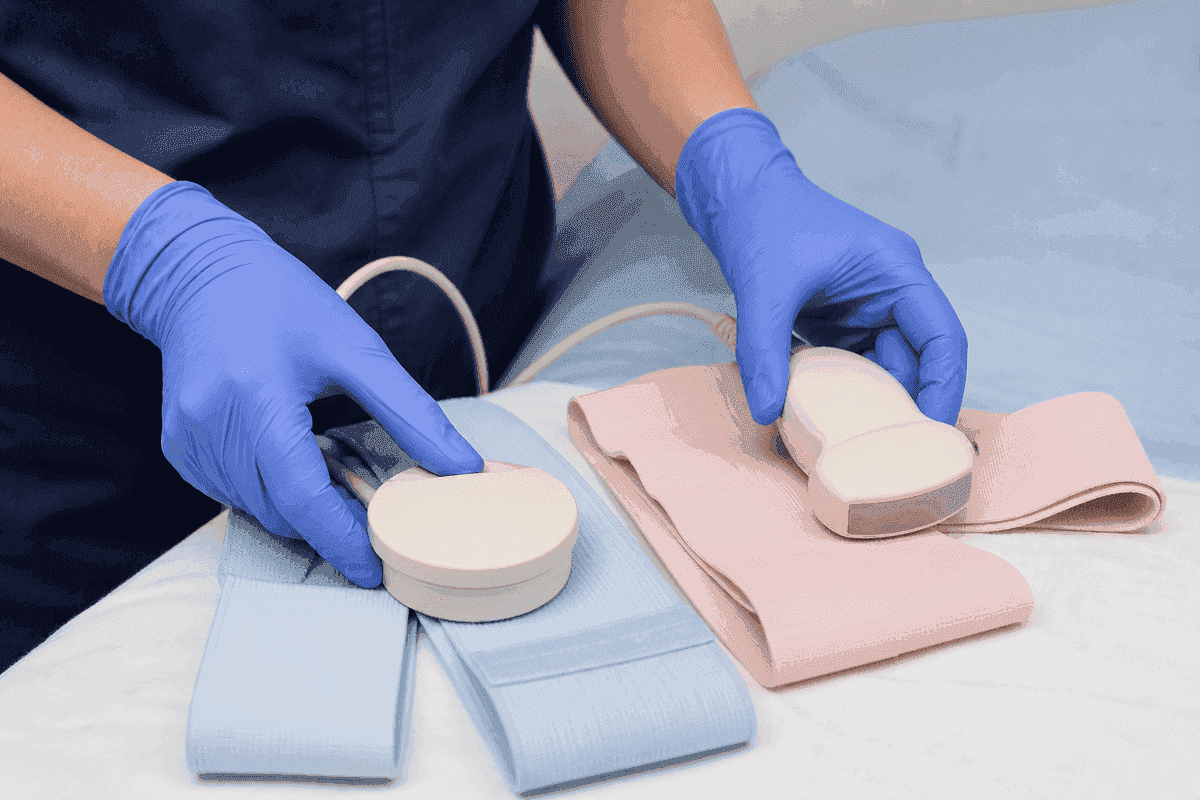
Intrauterine resuscitation restores oxygen delivery while the team decides next steps. If oxytocin is driving strong, frequent contractions, it is also driving the late pattern; so you stop oxytocin first, then open the oxygen pipeline and unload the uterus.
- Stop oxytocin if it is contributing to nonreassuring patterns.
- Reposition (often left lateral).
- Oxygen and IV fluid bolus per protocol.
- Notify the provider and prepare for possible expedited birth.
Left lateral rolls the uterus off the vena cava and can improve uterine perfusion. Oxygen and a fluid bolus support maternal oxygen content and placental filling as ordered. The exam favorite trap keeps the Pitocin running while you “fix position and give oxygen”; position and oxygen help, but they do not cancel an oxytocin-driven contraction storm. Cord prolapse after membrane rupture (check FHR first, lift the presenting part off a felt cord) is sequenced in Maternity emergencies.
Labor emergencies
These birth emergencies turn on one classic cue and one forbidden or required first move. Miss the cue and you keep pushing when you should call a team; pick the wrong pressure point and you worsen shoulder dystocia. Hypertensive crises, hemorrhage by fundus type, previa (no vaginal exam), abruption, and cord prolapse are owned by Maternity emergencies; teach the rows below in full here.
| Emergency | Classic cues | Priority |
|---|---|---|
| Shoulder dystocia | Head delivers, retracts (turtle sign); shoulder stuck | Call help; McRoberts; suprapubic pressure; no fundal pressure |
| Uterine rupture (VBAC risk) | Sudden tearing pain, contractions stop, fetal bradycardia | Emergency cesarean pathway |
| Precipitous birth | Labor under about 3 hours | Support birth; watch closely for postpartum hemorrhage |
| Amniotic fluid embolism pattern | Sudden dyspnea, cyanosis, collapse after birth | Resuscitation / emergency response |
| Failure to progress | No cervical change with inadequate contractions | Notify; anticipate augmentation or other plan; FHR still rules |
Shoulder dystocia: the head delivers, then pulls back tight against the perineum (turtle sign) because the anterior shoulder is caught behind the pubic bone. Call for help immediately. McRoberts (sharp maternal hip flexion) flattens the sacral promontory and widens the pelvic inlet angle; suprapubic pressure aims to collapse the stuck shoulder under the pubic bone. Fundal pressure drives the shoulder harder into the obstruction and raises rupture and injury risk; that is why it is never the exam answer.

Safety
Fundal pressure is not a shoulder dystocia fix. Suprapubic pressure and McRoberts positioning are the exam moves.
Uterine rupture is the VBAC nightmare: sudden tearing or ripping pain, contractions that stop or the uterus that goes quiet, and fetal bradycardia or loss of station. The scarred uterus has opened; maternal-fetal circulation collapses. This is an emergency cesarean pathway, not more oxytocin or “watch another contraction.” The distractor treats sudden pain as labor intensity and keeps pushing induction.
Precipitous birth (labor under about three hours) finishes so fast that soft tissue tears, exhaustion, and postpartum hemorrhage risk rise. Support a controlled delivery when you can, protect the newborn on arrival, then watch the fundus and bleeding closely; rapid labor does not mean a calm recovery. Full boggy-versus-firm hemorrhage sequencing is in Maternity emergencies.
Amniotic fluid embolism is rare and catastrophic on the exam: sudden dyspnea, cyanosis, hypotension or collapse around birth. Treat it as a resuscitation emergency; airway, breathing, circulation, and obstetric team; not as ordinary postpartum shortness of breath from exertion. Do not delay care waiting for a definitive label at the base of the bed.
Failure to progress means inadequate cervical change despite a trial of labor, often with inadequate contractions. Notify and anticipate augmentation, rest, or another birth plan as ordered. The trap is chasing progress so hard that you ignore a nonreassuring FHR; the strip still outranks the dilation clock.
Labor analgesia: hypotension, bladder, red-flag block
Systemic opioids take the edge off early labor but sedate the mother and can depress the newborn; time them with the obstetric plan and have neonatal respiratory support ready. Nitrous or local infiltration appear as stem details; they do not replace watching the strip.
An epidural blocks pain by bathing lumbar nerve roots. The same block can drop sympathetic tone, so blood pressure falls and the placenta is under-perfused. Preload with IV fluid as ordered and keep a left tilt so the uterus is off the vena cava. Recheck BP on a schedule after the bolus. A drop with late decelerations is intrauterine resuscitation plus ephedrine/phenylephrine as ordered, not “wait for the next pressure.” The bladder will not tell her it is full; catheterize as protocol so a full bladder does not stall descent. Motor block is expected to some degree; rising weakness, a sensory level that climbs toward the chest, or sudden dyspnea is a high block: sit up as directed, airway support, crash-cart thinking. After the catheter is out, severe back pain, new bowel or bladder loss, or a dense motor block that will not recede is epidural hematoma until proven otherwise: notify now, not “walk it off.” A spinal (wet-tap) headache is positional; caffeine and a blood patch as ordered, not a discharge-home shrug if she cannot sit up.
| Problem | Why it happens | First stance |
|---|---|---|
| Hypotension after epidural | Vasodilation plus aortocaval compression | Left tilt, fluids as ordered, notify; watch the FHR |
| Full bladder, slow descent | Block hides the urge to void | Empty the bladder per protocol |
| High block / dyspnea | Local anesthetic climbed | Airway, oxygen, obstetric anesthesia help |
| New severe back pain + motor/bowel change after | Hematoma compressing the cord | Emergency notify; this is not ordinary sore-back labor |
Contraception and gynecologic red flags
Contraception teaching on the exam is less about brand names and more about danger signs, who should not get estrogen, and what actually blocks STIs. Gynecologic red flags (cyclic pain, menopause bone risk, new breast changes) are report-and-evaluate cues, not reassurance-as-normal.
- Combined estrogen-progestin pills: teach ACHES stop-and-call symptoms.
- Age 35+ and smoking is a classic reason to avoid combined hormonal contraception.
- Only barrier methods (e.g., condoms) also reduce STI transmission among common options tested.
- Endometriosis pattern: cyclic pelvic pain and dyspareunia around menses.
- Menopause estrogen loss raises osteoporosis and other long-term risks taught on the exam.
- Report new breast lumps or nipple discharge as directed.
ACHES on combined oral contraceptives maps to clot and vascular emergencies: severe Abdominal pain (liver/gallbladder/clot pathways), Chest pain or shortness of breath (PE/MI concern), severe Headache (stroke concern), Eye changes (vascular/retinal concern), Severe leg pain or swelling (DVT). Estrogen raises clotting tendency; these symptoms mean stop the pill and seek care, not “give it two more weeks to adjust.” The distractor normalizes ACHES as expected early side effects.
Age 35+ with smoking plus estrogen is a classic high clot-risk pairing on the exam; hold or clarify a safer method rather than refill combined pills. Progestin-only or nonhormonal options may be appropriate depending on the stem; the rule is do not keep estrogen running in that risk cluster without obstetric/gyn clarification.
Condoms (and other barriers) reduce STI transmission; most hormonal methods prevent pregnancy but do not block pathogens. Clients who need STI protection still need barrier teaching even when they are happy with the pill. Endometriosis pain that cycles with menses and hurts with intercourse is tissue responding to hormonal swings outside the uterus; escalate for evaluation, not “period pain, tough it out.” Menopause estrogen loss accelerates bone loss; osteoporosis risk teaching belongs in counseling. New breast lumps or nipple discharge need directed reporting; do not dismiss them as hormonal noise without assessment.
Priority map
| Picture | First move |
|---|---|
| Oxytocin + recurrent lates | Stop oxytocin; intrauterine resuscitation |
| Turtle sign at birth | Shoulder dystocia team maneuvers |
| VBAC + tearing pain + quiet uterus | Rupture emergency |
| ACHES on the pill | Stop pill; urgent evaluation |
| Smoker 39 yo wants combined OCP | Hold/clarify safer method |
| Need to place the ultrasound transducer | Leopold first: find the back |
| Turtle sign | McRoberts + suprapubic; never fundal pressure |
| Epidural, BP dropping, lates | Tilt, fluids as ordered, notify; treat as perfusion problem |
| Post-epidural: cannot move legs + new incontinence | Hematoma pathway; do not send home |
Revision
Must know
- 1Normal term FHR baseline is commonly about 110-160 beats/min.
- 2Early decelerations mirror contractions (head compression). Variables are abrupt/variable shape (cord). Lates start after contraction peak (uteroplacental insufficiency); act.
- 3Recurrent lates + oxytocin: stop oxytocin first, then reposition, oxygen/fluids per protocol, notify.
- 4Shoulder dystocia: head delivers then turtle-signs back; call for help, McRoberts, suprapubic pressure as directed; not fundal pressure.
- 5VBAC sudden tearing pain, contractions stop, fetal bradycardia: suspect uterine rupture; emergency birth pathway.
- 6Precipitous birth: watch for PPH and maternal exhaustion/trauma.
- 7Amniotic fluid embolism picture: sudden dyspnea, cyanosis, hypotension/collapse after birth; emergency resuscitation.
- 8Combined oral contraceptives: ACHES (Abdominal pain, Chest pain, Headaches severe, Eye changes, Severe leg pain) → stop and seek care. Smoking + age raises clot risk with estrogen pills.
- 9Condoms help protect against STIs; most hormonal methods do not.
- 10Labor stages: first is dilation (latent then active), second is pushing to birth, third is placenta, fourth is immediate recovery with hemorrhage watch.
- 114 Ps: Powers (contractions), Passage (pelvis), Passenger (fetus), Psyche. Leopold maps lie, presentation, and engagement before the monitor belts go on.
- 12Epidural: preload and left tilt for hypotension; empty the bladder. Report rising motor block, severe back pain, or bowel/bladder change after (hematoma/high block). Opioids: maternal sedation and newborn respiratory depression watch.
Memory hooks
VEAL CHOP
Variable→Cord; Early→Head; Acceleration→OK; Late→Placental insufficiency.
Stop the Pit for lates
Oxytocin plus recurrent late decelerations: stop the oxytocin before you tidy anything else.
ACHES means stop the pill
Severe abdominal, chest, headache, eye, or leg pain on combined pills is a stop-and-be-seen list.
Four stages, then watch the fundus
Dilation, birth, placenta, then the first hours when atony shows up. Stage four is not a snack break.
On the exam
How it's tested
Stems show late decelerations on oxytocin, a turtling head at birth, sudden VBAC pain with a quiet uterus, hypotension after an epidural, a smoker asking for estrogen pills, or which Leopold step finds the presenting part. Distractors keep oxytocin running, push on the fundus for shoulder dystocia, walk off a post-epidural motor block, or reassure ACHES as normal pill adjustment.
More in maternity and newborn
All topics- Maternity emergenciesNCLEX maternity emergencies: preeclampsia/HELLP and magnesium toxicity, ectopic and mole, cerclage, abruption vs previa, PPH, cord prolapse, TORCH/GDM crises, cardiac disease with postpartum autotransfusion, and tachysystole.Read
- Newborn metabolic and respiratory complicationsNCLEX newborn chapter: IDM hypoglycemia, hypothermia, TTN vs RDS vs meconium, phototherapy, PKU/hypothyroid screens, plus NEC, ROP, IVH, NAS/FASD, and SGA/LGA risk.Read
- Postpartum careNCLEX postpartum chapter: fundus and lochia, atony vs laceration vs retained placenta, endometritis, mastitis, DVT/PE, and blues vs depression vs psychosis.Read
- Prenatal careNCLEX prenatal chapter: Naegele and GTPAL, danger signs, GDM screening and teaching, TORCH exposures, NST/BPP/fibronectin testing, and fetal circulation shunts that close after birth.Read