Paediatrics
Paediatric fluid and newborn
NCLEX pediatric fluid chapter: dehydration severity, oral rehydration first when able, shock priorities, newborn normals vs red flags, Apgar, reflexes, and infant CPR on a firm surface.
ClesialReviewed by Sophia Bennett, RN
Contents7 sections
Pediatric fluid and newborn items are pattern recognition: who can still drink their way out of dehydration, who is in shock, and which newborn finding is cute versus critical.
Dehydration and rehydration
Infants and young children lose fluid fast; higher surface-area-to-mass ratio, immature kidneys, and often vomiting or diarrhea that empties the tank before parents notice. The exam decision is not “is the child a little dry?” It is whether the child can still take oral rehydration safely, or whether perfusion and mentation say the circulatory system is already failing.
Severity lives in the whole picture, not one dry lip. An alert child with tears still possible, moist mucosa, and willingness to drink is usually mild-to-moderate dehydration; the gut still works as a fluid route. Oral rehydration solution (ORT) in small, frequent sips or syringe volumes replaces water and electrolytes without the risks of an unnecessary IV. Large gulps that trigger more vomiting defeat the plan; tiny repeated volumes win.
| Severity picture | First approach |
|---|---|
| Alert, tears possible, moist mucosa, drinking | ORT in small frequent sips/volumes |
| Listless, sunken eyes/fontanel, oliguria, marked tachycardia | Urgent evaluation; IV fluids for severe/shock |
| After fluids: more alert, voids, HR improving | Therapeutic response; continue plan |
When the child is listless, eyes or fontanel sunken, mucosa very dry, urine scarce, skin cool or mottled, and heart rate high, you are looking at severe dehydration or shock physiology. Capillary refill stretches and mental status dulls because stroke volume is falling. That child needs urgent evaluation and IV (or IO if IV fails) isotonic fluid as ordered; not another hour of “try a few more sips.” ORT requires a working gut and enough alertness to protect the airway while drinking; neither is reliable in shock.
| Assessment focus | Mild-moderate (often ORT) | Severe / shock (IV/IO) |
|---|---|---|
| Mentation | Alert, interactive | Listless, hard to arouse |
| Eyes / fontanel | Normal or slightly sunken | Sunken; fontanel depressed |
| Mucosa / tears | Moist; tears possible | Very dry; tears absent |
| Perfusion | Warm; HR up a little | Cool/mottled; marked tachycardia; delayed refill |
| Urine | Decreased but some voids | Oliguria / anuria pattern |
- Assess mental status, perfusion, mucous membranes, fontanel, urine.
- Choose ORT when the child is alert and can take oral fluids.
- For shock/severe dehydration, establish IV/IO access and give isotonic boluses as ordered.
- Reassess often; compensated shock can tip quickly in infants.
Children compensate hard before they crash. Tachycardia and poor perfusion appear early; hypotension is late because young vessels clamp down until reserves are nearly gone. Waiting for a low blood pressure to start fluids is the classic miss. Reassess after each bolus or ORT trial: alertness, tears, moist mucosa, urine return, and heart rate trending down mean the plan is working. Flat affect with ongoing oliguria and rising tachycardia means escalate, not “give it more time.”
Safety
Hypotension is a late shock sign in children. Do not wait for a low BP to treat poor perfusion and severe dehydration.
ORT technique matters as much as the choice: small frequent volumes (sip or syringe) of oral rehydration solution beat large gulps of water or sugary soda that trigger more vomiting or wrong electrolyte ratios. If vomiting continues despite tiny volumes, or mentation worsens, switch pathways; do not “prove” ORT while the child slides toward shock.
Serial weights are a quiet truth-teller in infants: acute drop tracks water loss; gain after rehydration tracks recovery when the scale and clothing are consistent. The distractor that looks decisive is starting an IV on every gastroenteritis, or sending a lethargic, sunken-fontanel infant home on “push fluids.” Match the route to the severity picture, then prove response with mentation, perfusion, and urine; not with hope alone.
Newborn assessment and reflexes
Newborn stems split findings into two piles: expected transition quirks versus signs that the baby is not oxygenating, feeding, or neurologically intact. The trap is normalizing something dangerous (central cyanosis as “newborn blue”) or panicking about something expected (acrocyanosis, brief irregular pauses). Name the finding, then ask whether it threatens airway, perfusion, infection, or neurologic function.
Apgar is a one- and five-minute snapshot of transition; Appearance, Pulse, Grimace, Activity, Respiration; not a lifelong intelligence or outcome score. It tells you how the baby looked coming through the first minutes and whether resuscitation needs to escalate. Do not use a low Apgar alone to predict school performance, and do not treat a reassuring Apgar as a free pass to ignore later distress.
| Usually expected | Report / escalate |
|---|---|
| Acrocyanosis in the first day | Central cyanosis |
| Irregular breathing with brief pauses | Grunting, flaring, retractions, apnea spells of concern |
| Moro, rooting, suck, palmar/plantar grasp present | Absent key reflexes in a term newborn |
| Cord drying / small dried blood on diaper edge | Cord redness, purulent drainage, foul odor |
| Soft fontanel, appropriate for hydration | Bulging or markedly sunken with illness cues |
Hands and feet can stay bluish (acrocyanosis) early while the baby is still shifting circulation; the trunk and mucous membranes should pink up with good effort. Central cyanosis; blue lips, tongue, or trunk; means inadequate oxygenation until proven otherwise: support airway and breathing and escalate. Periodic breathing with short pauses under about 20 seconds can be expected in newborns; grunting, nasal flaring, retractions, or prolonged apnea are work-of-breathing emergencies, not “wait and see” quirks.
Primitive reflexes (Moro, rooting, suck, palmar and plantar grasp) show an intact neurologic circuit for that age. Absent key reflexes in a term newborn, or a floppy, poorly responsive baby, is not “sleepy from birth” until you have ruled out illness, injury, or hypoglycemia. Soft fontanels that feel appropriate fit hydration; a bulging fontanel with illness cues or a markedly sunken one with dehydration signs belongs with the whole clinical picture, not as a single isolated label.
- Apgar is a transition score at 1 and 5 minutes, not a developmental prediction.
- Teach parents cord care: clean, dry, fold diaper below the stump, report infection signs.
- Jitteriness with poor feeding, tone changes, or color change needs glucose/workup thinking, not dismissal as “normal newborn shake.”
The cord stump should dry and separate; keep it clean and dry, fold the diaper below so urine does not soak it, and expect a little dried blood at the diaper edge. Redness, foul odor, or purulent drainage means infection risk; report, do not paint over with home remedies that keep the stump wet. Jitteriness alone can be startle; jitteriness plus poor feeding, tone change, or color change is a glucose and sepsis-thinking problem until workup says otherwise.
The distractor that looks parental is calling central cyanosis normal, ignoring grunting because “newborns sound funny,” or scoring Apgar as a developmental forecast. Another miss: dismissing bilious vomiting, temperature instability, or no void/stool past expected windows as routine. Expected findings get teaching; red-flag findings get escalation.
Infant CPR on a firm surface
A pulseless or gasping infant is a circulation problem, not a “stimulate and watch” problem. Dry and stimulate a newly born infant first when that is the NRP story; if the heart rate stays critically low despite ventilation, you compress. Place the infant on a firm surface. One rescuer: two fingers on the lower sternum, just below the nipple line, about one-third of the chest depth, full recoil. Two rescuers: two thumbs with fingers encircling the chest is stronger and preferred when you have the hands. Coordinate breaths with compressions per current BLS/NRP in the stem (the exam still cares that you do not pause forever to debate ratios). Recheck the pulse only at the taught intervals. The distractor uses adult two-hand depth on a tiny sternum, or starts compressions on a crying infant with a pulse because the Apgar was 6.
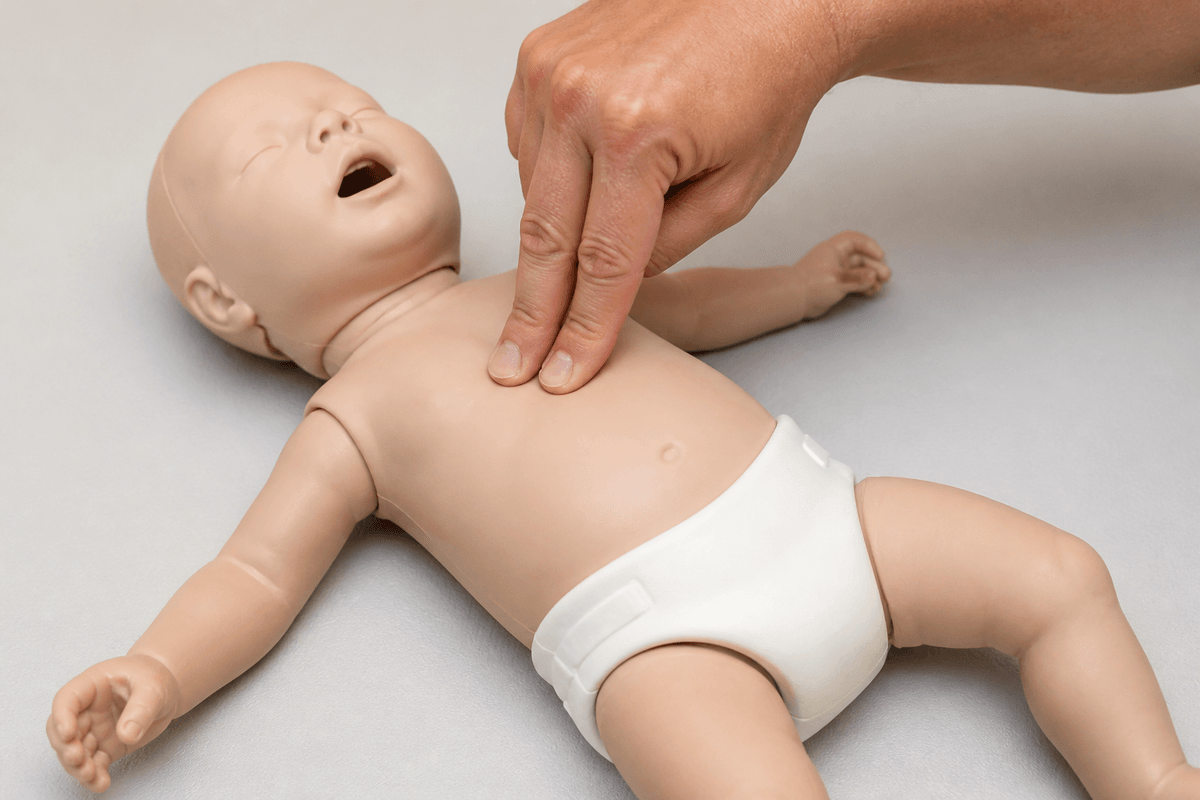
If the story is choking with effective cough, do not start CPR. Severe FBAO in a still-responsive infant is back blows and chest thrusts; a child past infancy gets abdominal thrusts. Those sequences are owned by Pediatric acute emergencies. Once the infant is unresponsive, you are in this CPR map and you look in the mouth only when you can see the object. Blind finger sweeps push the grape farther down.
Priority map
| Picture | First move |
|---|---|
| Alert dehydrated toddler taking sips | ORT first |
| Lethargic infant, sunken fontanel, poor perfusion | IV fluid / shock pathway |
| Central cyanosis in nursery | Report/escalate airway-breathing support |
| Apgar question | Appearance, Pulse, Grimace, Activity, Respiration |
| Pulseless infant | Firm surface; two-finger or two-thumb CPR |
Revision
Must know
- 1Mild-moderate dehydration in an alert child who can drink: oral rehydration solution in small frequent amounts first.
- 2Severe dehydration / shock cues: lethargy, sunken eyes/fontanel, very dry mucous membranes, poor turgor, cool mottled skin, tachycardia then hypotension late; IV fluids now.
- 3Improving after fluids: better alertness, tears, moist mucosa, urine output returning, HR trending down.
- 4Apgar evaluates Appearance, Pulse, Grimace, Activity, Respiration at 1 and 5 minutes; not a long-term IQ score.
- 5Infant CPR: firm surface, two fingers on the lower sternum (or two-thumb encircling with two rescuers), compress about one-third of chest depth, allow recoil. Unresponsive FBAO becomes CPR; look for the object only when you can see it. Full FBAO maneuvers for a still-conscious infant live in Pediatric acute emergencies.
- 6Expected newborn: irregular breathing pattern with occasional pauses under 20 seconds, acrocyanosis early, milia, mongolian spots, positive Moro/rooting/suck/grasp as age-appropriate.
- 7Report: central cyanosis, grunting/flaring/retractions, absent or unequal breath sounds concern, bilious vomiting, no void/stool beyond expected windows, jitteriness with other illness cues, temperature instability.
- 8Cord stump: keep clean and dry; small dried blood at diaper edge can be expected; report redness, odor, discharge.
Memory hooks
Sips before sticks when they can drink
Alert mild-to-moderate dehydration gets ORT first. IV is for severe or failed oral intake.
Apgar is the first report card
Appearance, Pulse, Grimace, Activity, Respiration; scored at 1 and 5 minutes.
Blue hands early, blue center never OK
Acrocyanosis can be expected early. Central cyanosis is a report-now finding.
On the exam
How it's tested
Stems ask ORT vs IV, which infant finding is severe dehydration, Apgar meaning, which newborn cue to report, or two-finger vs two-thumb infant CPR. Distractors start IV on every mild gastroenteritis, treat central cyanosis as normal, or use adult two-hand compressions on a tiny sternum.
More in paediatrics
All topics- Immunisation and HIVNCLEX vaccine safety and HIV chapter: live-vaccine holds, mild-illness myths, CD4 and opportunistic infection risk, transmission teaching, and ART adherence cues.Read
- Paediatric blood and cancerNCLEX pediatric hematology-oncology: sickle cell, hemophilia, vWD/thalassemia/aplastic, iron teaching, leukemia precautions, Wilms (do not palpate), plus neuroblastoma, osteosarcoma, and Hodgkin.Read
- Paediatric renal and musculoskeletalNCLEX pediatric renal-MSK chapter: AGN versus nephrotic, UTI, HUS/VUR/enuresis, hypospadias, casts, Pavlik, Gower sign, plus JIA, Legg-Calvé-Perthes, and osteomyelitis.Read
- Paediatric skin, ENT, and safeguardingNCLEX pediatric ENT and skin: tonsillectomy bleed cues, ear and eye infection teaching, lice and impetigo control, eczema care, and mandatory reporting for maltreatment.Read