Health promotion and development
Older adult safety and immobility
NCLEX older-adult chapter: normal aging vs report-now changes, delirium vs dementia, fall prevention, immobility complications, and cane walker crutch gait rules.
ClesialReviewed by Sophia Bennett, RN
Contents8 sections
Older-adult items separate expected aging from acute danger, then ask whether you can keep someone upright safely and protect skin and lungs when they cannot move.
Normal aging vs report now
Older-adult stems often hide the real question inside the word “aging.” Expected change is gradual, bilateral or symmetric when sensory, and already known to the client. Acute danger is new, sudden, asymmetric, or paired with infection or neuro red flags. If the finding would make you call a rapid response in a 40-year-old, it is not “just age” in an 80-year-old either.
| Often expected with aging | Not normal; escalate |
|---|---|
| Drier thinner skin, greying hair, slower gait | Sudden confusion, agitation, or new lethargy |
| Presbyopia; milder high-frequency hearing loss | Acute vision loss, new unequal pupils, stroke signs |
| Mild decrease in taste/smell; nocturia patterns that are chronic and known | New incontinence with fever, or urinary retention with overflow |
Why new confusion fails the “normal aging” test: delirium is common in older adults and often the first sign of infection, hypoxia, medication effect, or metabolic derangement. Gradual mild forgetfulness over years is a different picture from overnight agitation or new lethargy. Treat acute mental-status change as report-now until a cause is ruled out; do not reassure the family that “old people get confused.”
Sensory aging is usually slow: needing reading glasses (presbyopia) or asking people to repeat softer consonants is common. Sudden vision loss, a new pupil difference, facial droop, or unilateral weakness is stroke territory. Same logic for elimination: long-standing nocturia the client already manages is not the same as new incontinence with fever (think UTI) or overflow dribble with retention (think obstruction or atony). Name the timeline before you name the age.
The distractor that looks gentle is chalking every change up to “getting older” so you delay assessment. Another miss: treating chronic dry skin or greying hair as if they need the same urgency as delirium. Expected aging still needs skin protection and fall precautions; it does not need an emergency workup by itself. New + sudden + neurologic or infectious cues get escalated.
Delirium vs dementia
The note claims this comparison because the exam uses it to trap anyone who treats confusion as a personality. Delirium is an acute brain failure: hours to days, attention waxes and wanes, often worse at night, and there is almost always a driver (UTI, pneumonia, hypoxia, anticholinergic load, withdrawal, electrolyte swing, pain, unfamiliar ICU). Dementia is a slow neurodegenerative course: months to years, memory and function erode, and the person is usually alert even when they cannot name the year. Sundowning can look like delirium; the timeline still decides. New overnight agitation in a previously baseline older adult is delirium until the workup says otherwise.
| Feature | Delirium | Dementia |
|---|---|---|
| Onset | Hours to days; family says “this is new” | Months to years; slow decline |
| Attention | Fluctuates; cannot stay on a question | Usually able to attend, even if answers are wrong |
| Course in 24 hours | Up and down, often worse at night | Relatively stable day to day |
| Reversibility | Often improves when the cause is treated | Not reversed by antibiotics or oxygen |
| First nursing move | Safety, find the driver, least-restrictive watch | Routine, orientation aids, do not argue facts in late disease |
Why infection shows up as confusion: an older adult may never spike a “impressive” fever. The brain is the canary. Hypoxia, hypoglycemia, and drug effects do the same. You still protect: bed low, sitter or close observation, glasses and hearing aids on so sensory loss does not add to the picture, and you do not start with four side rails and a vest because “they might fall.” Restraints worsen agitation and injury. Reality orientation helps mild confusion; in advanced dementia, repeated quizzing (“What year is it?”) only agitates. Meet the emotion, keep the routine, and treat pain. Alzheimer drug teaching (donepezil does not cure) lives in Neurologic medications. Reporting elder abuse lives in Elder abuse and polypharmacy.
The distractor that looks kind is telling the family this is “just aging” at 2 a.m., or locking the client in restraints so you can finish med pass. Another miss: forcing an advanced-dementia client to “reorient” to a calendar they cannot use, then documenting noncompliance. Name the tempo, search for the reversible cause, keep them safe with the least restriction that works.
Fall prevention
Most inpatient falls are predictable. Older adults lose muscle power, proprioception, and night vision; many take drugs that drop blood pressure or dull alertness. Fix the environment and the first stand of the day; that is when orthostasis and a full bladder collide.
| Risk driver | Why it drops people | Nursing move |
|---|---|---|
| Orthostatic hypotension | Blood pools in the legs on standing; brain perfusion dips | Lie → sit → stand; dangle; hydrate as allowed; report dizziness |
| Toileting urgency at night | Rush + dim light + polished floor | Scheduled toileting; night light; non-slip footwear; bed low |
| Clutter / unfamiliar layout | Trip hazards the client cannot see or remember | Clear path; call light in reach; orient to room |
| New confusion / delirium | Misjudges distance and ignores the call light | Closer observation; sitter as needed; treat cause; not first-line soft restraints |
- Keep the bed in the lowest safe position and the call light within reach.
- Clear clutter, use adequate night lighting, and offer toileting before peak fall hours.
- Non-slip footwear beats bare socks on polished floors.
- Review meds that sedate or drop BP when falls cluster; escalate to the prescriber pathway.
The distractor that looks protective is reaching for restraints because the client “might fall.” Restraints raise injury and agitation risk and are a last resort after less restrictive options. Another miss: walking a client who just sat up dizzy because “ambulation prevents DVT”; fix orthostasis first, then walk with help.
Immobility complications
Bed rest is not restful for lungs, veins, skin, or bowels. Without movement, alveoli collapse, calf veins clot, skin over bone dies, and the gut slows. Anticipate the complication and prevent it before the stem names the crisis.
| System | Complication | Why immobility causes it | Prevention focus |
|---|---|---|---|
| Lungs | Atelectasis / pneumonia | Shallow breathing; pooled secretions | Turn, cough, deep breathe, incentive spirometry, upright when able |
| Veins | DVT / PE | Stasis in calf veins; clot embolizes to lung | Ambulation, leg exercises, compression, anticoagulation when ordered |
| Skin | Pressure injury | Capillaries closed under bony prominences | Reposition on schedule, dry clean skin, pressure off bony prominences |
| GI / GU | Constipation, retention | Less motility and privacy; opioids add risk | Fluids/fiber as allowed, toileting schedule |
| Muscles / bones | Contractures, weakness, bone loss | Disuse atrophy; joints stiffen in poor alignment | ROM, early mobility, proper alignment |
Safety
Immobile client with sudden shortness of breath, chest pain, and tachycardia: treat as possible pulmonary embolism and escalate. Do not chalk it up to anxiety alone.
Why PE looks like “anxiety” on a distractor: sudden dyspnea and tachycardia are nonspecific, but in a client who has been in bed the clot pathway is the priority until proven otherwise. Do not send them for a casual walk to “calm down” while you ignore hypoxia cues. Full pressure-injury staging depth also lives in Wound and pressure injury care; the map below is the exam word list you still need here.
Pressure injury staging (use words, not guesses from a photo)
| Stage / category | What you see |
|---|---|
| Stage 1 | Intact skin, localized non-blanchable erythema |
| Stage 2 | Partial-thickness loss; shallow open ulcer or intact/ruptured blister |
| Stage 3 | Full-thickness to subcutaneous fat; no exposed bone/tendon/muscle |
| Stage 4 | Full-thickness with exposed bone, tendon, or muscle |
| Unstageable | Base covered by slough/eschar so depth cannot be seen |
| Deep tissue injury | Persistent non-blanchable deep red, maroon, or purple discoloration |
Stage from the words in the stem. Intact non-blanchable redness is Stage 1; offload, do not massage. Maroon or purple intact skin over a pressure point is deep tissue injury, not “just a bruise.” Fat without bone is Stage 3; bone, tendon, or muscle on view is Stage 4. If slough or eschar hides the base, call it unstageable and describe what you see.
Assistive devices and positioning
Device questions reward the nurse who places the aid where physics helps the weak side, then keeps weight on a stable base. Positioning questions reward the same habit: protect the joint or the airway the stem is worried about, not “whatever looks comfortable.”
| Device | Core teaching |
|---|---|
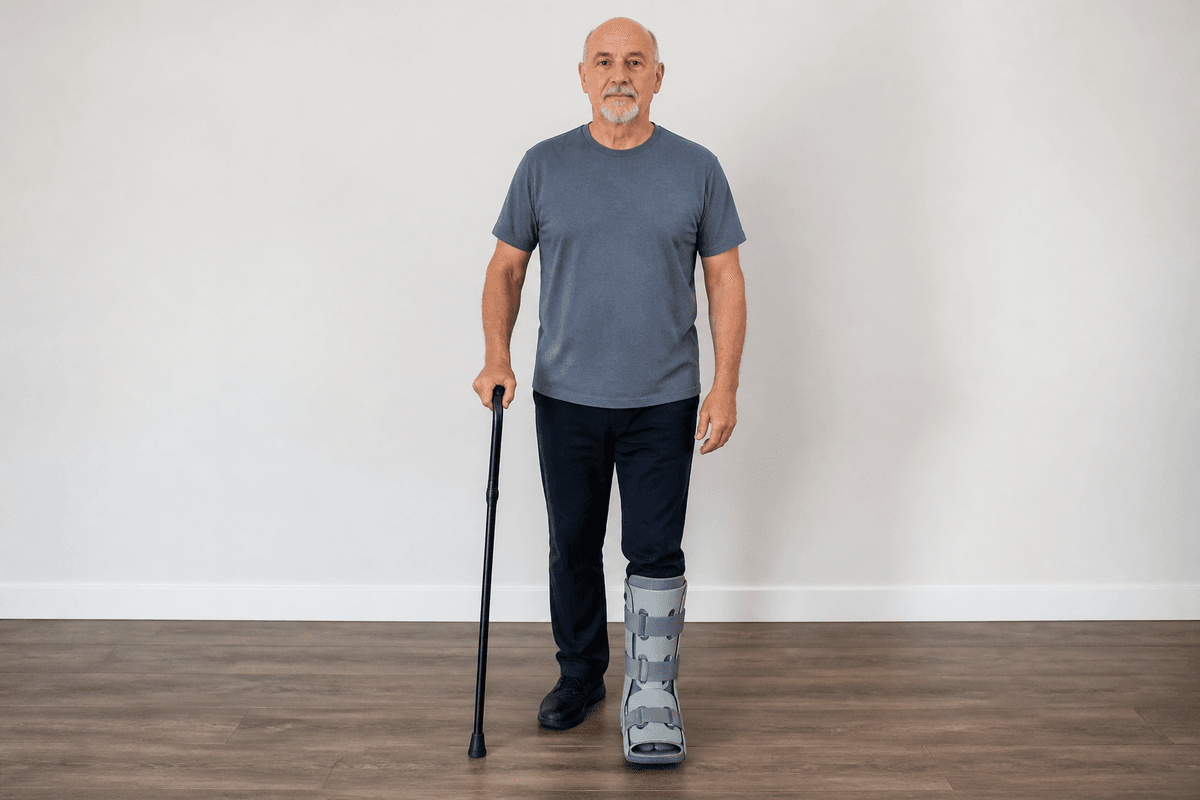
| Cane | Hold on the **stronger** side; move cane forward with the weaker leg |
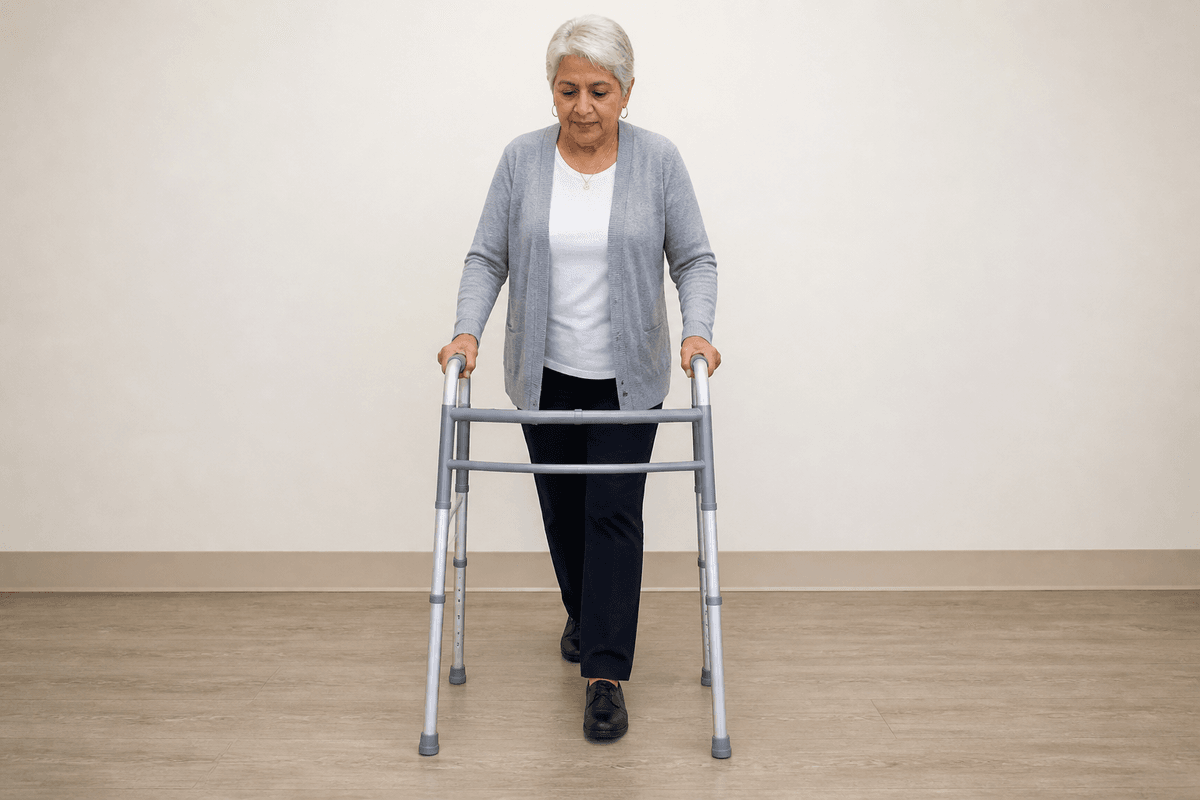
| Walker | Advance walker, all tips/wheels stable, then step in; do not use as a sled to lean far ahead |
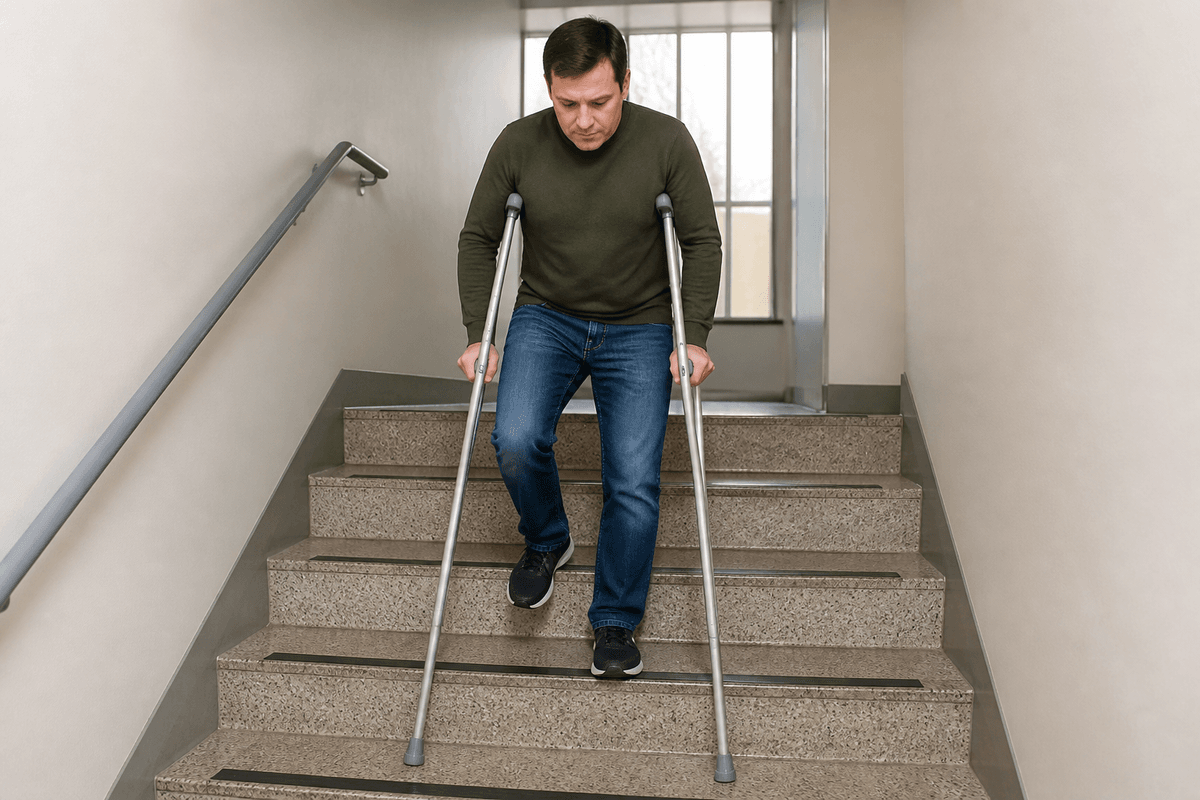
| Crutches (stairs) | Up: strong leg first. Down: crutches and weaker side first |
| Crutch fit | About 2–3 finger widths below the axilla; elbows slightly flexed on the grips; weight through the hands, never hanging on the pads |
| Posterior hip arthroplasty | Avoid excessive flexion, crossing legs, and internal rotation as taught |
| Airway risk / obtunded | Side-lying or other ordered recovery position to protect the airway from secretions |
| Suspected air embolism (line removal) | Occlude site, left side, Trendelenburg if protocol allows, oxygen, notify |
Why the cane goes on the stronger side: the cane and the weaker leg move together so the strong leg and the cane share load when the weak leg is in stance. Holding the cane on the weak side collapses that partnership and leaves the client tipping toward the deficit. Advance cane with the weaker leg, then step through with the stronger leg; do not plant the cane and hop the good leg first while the weak side trails unsupported.
Walkers need all tips or wheels down before the client bears weight into them. Step into the frame; do not lean far over a walker you are still rolling ahead like a shopping cart.
Crutch gaits (match the weight-bearing order)
Gait names tell you how many points of contact move as a set. Pick the gait the stem’s weight-bearing status allows. A client who must keep one foot off the floor cannot use a four-point gait; that pattern needs both feet. Axillary pads are not handles: hanging the armpits on the crutches stretches the brachial plexus and makes hands numb. Fit first, then coach the pattern.
| Gait | How it moves | When the stem fits |
|---|---|---|
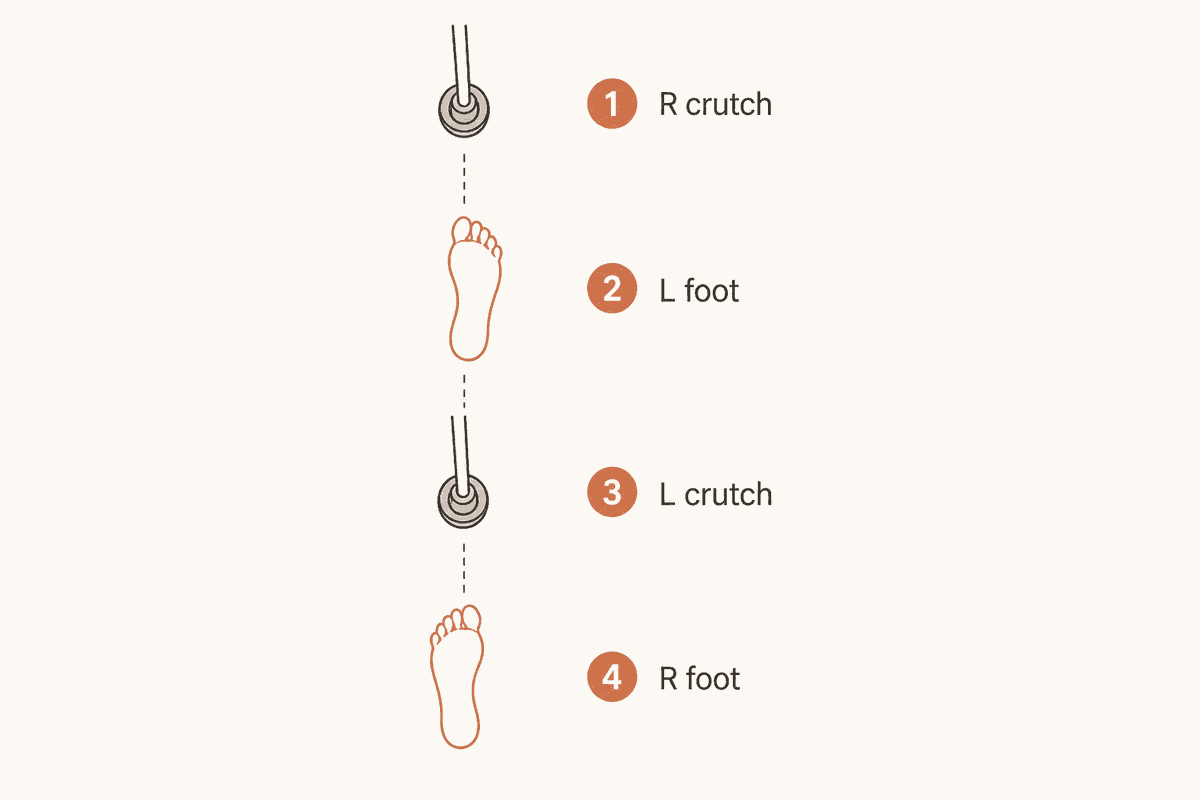
| Two-point | Opposite crutch and foot advance together (right crutch + left foot, then left crutch + right foot) | Partial weight-bearing, closer to a cane rhythm, needs more balance |
| Three-point | Both crutches and the weaker or non-weight-bearing side move together, then the strong leg steps through | Non-weight-bearing or touch-down on one side; the classic “keep it off the floor” stem |
| Four-point | One point at a time: crutch, opposite foot, other crutch, other foot | Slow, both legs can take some weight, poorest balance, safest when rushed walking would drop them |
| Swing-through | Both crutches forward, then both legs swing past the crutches | Selected clients with strong arms and ordered swing pattern (paraplegia teaching on some stems) |
On stairs, remember up with the good, down with the bad: the strong leg powers the climb; going down, crutches and the weaker side lead so the strong leg controls the descent. Guard on the weaker side when you assist so you can catch the fall direction.
Posterior hip precautions exist to keep the new joint from popping out of the socket: avoid flexing past about 90° (deep chairs, bending to tie shoes the wrong way), adduction past midline (crossing legs), and internal rotation as taught. Airway-risk or obtunded clients need a recovery/side-lying position so secretions do not pool into the airway. Suspected air embolism after line removal is a different emergency map; occlude the site, left side, Trendelenburg if protocol allows, oxygen, notify; do not sit them upright “to breathe easier.”
- Match the device to the weakness pattern before coaching gait.
- Guard on the weaker side during ambulation when assisting.
- Teach stair and hip rules before the first unsupervised try.
- Reassess dizziness and vitals after prolonged bed rest before the first chair transfer.
The distractor that looks helpful is putting the cane on the weak side “so that side has support,” letting the client lean far over a moving walker, sending them up stairs weak-leg-first, or coaching four-point gait when one foot must stay off the floor. Another miss: deep hip flexion in a low recliner after posterior hip arthroplasty, or leaving an obtunded client fully supine when secretions are the risk. Match the device, the gait, and the joint rules to the weakness and the surgery before the first unsupervised walk.
Revision
Must know
- 1Normal aging can include thinner skin, slower reflexes, presbyopia, and milder hearing loss. New confusion, sudden incontinence, or focal neuro change is not “just aging.”
- 2Fall prevention: bed low, call light in reach, clear path, non-slip footwear, toileting schedule, treat orthostasis by rising slowly.
- 3Orthostatic dizziness: dangle, stand slowly, sit if dizzy. Do not spring out of bed.
- 4Immobility complications: atelectasis/pneumonia, DVT/PE, pressure injury, constipation, contractures, orthostatic hypotension.
- 5Sudden dyspnea, chest pain, tachycardia in an immobile client: think PE until proven otherwise.
- 6Pressure injury staging (words): Stage 1 non-blanchable intact erythema; Stage 2 partial-thickness open or blister; Stage 3 full-thickness to fat; Stage 4 to muscle/bone; unstageable if base obscured; deep tissue injury is maroon/purple localized.
- 7Cane: hold on the stronger side; advance cane with the weaker leg.
- 8Walker: all walker legs down before weight-bearing; step into the walker, do not lean far over it.
- 9Crutch gaits: two-point is cane-like (opposite crutch and foot together); three-point moves both crutches with the weaker or non-weight-bearing side, then the strong leg; four-point is slowest (crutch, opposite foot, other crutch, other foot). Stairs: up with the good, down with the bad.
- 10Measure crutches: about 2–3 finger widths below the axilla; weight on the hand grips, not the armpits (brachial plexus risk).
- 11Delirium is acute and fluctuating, often from infection, hypoxia, or meds. Dementia is gradual. Treat new confusion as delirium until proven otherwise; do not first-line restrain.
- 12Posterior hip precautions: avoid hip flexion past about 90°, adduction past midline, and internal rotation as taught.
Memory hooks
Up with the good, down with the bad
Stairs on crutches: strong leg leads going up; weaker side and crutches lead going down.
Cane opposite the weak
Hold the cane on the stronger side so it partners with the weaker leg through the gait cycle.
New confusion is never just age
Acute mental status change in an older adult is a report-now finding until proven otherwise.
Delirium is hours; dementia is months
Sudden fluctuating confusion is delirium until you find the driver. Slow progressive memory loss is a different map.
On the exam
How it's tested
Stems ask which aging change is expected, which finding is delirium rather than dementia, which hand holds the cane, which crutch gait fits non-weight-bearing, or how to stage a sacral finding in words. Distractors treat overnight confusion as normal aging, put the cane on the weak side, or send a non-weight-bearing client up in a four-point gait.