Adult health
Musculoskeletal injury and surgery
NCLEX ortho chapter: fat embolism and compartment syndrome, rhabdomyolysis after crush or down time, cast neurovascular six Ps, hip precautions, traction weight rules, amputation care, and gout self-care basics.
ClesialReviewed by Sophia Bennett, RN
Contents8 sections
Orthopedic surgery and postoperative care items turn on mechanical emergencies: a cast that strangulates, fat that embolizes after a long bone breaks, a new hip that dislocates if the client bends past the rules, and immobilization devices (traction, casts) that only work when the weights hang free and distal checks stay honest.
Fracture complications: compartment, fat embolism, rhabdomyolysis
After a fracture or cast, the two emergencies that rewrite the priority list are rising pressure inside a muscle compartment and fat traveling from marrow into the lungs and brain. Both look like give more pain meds or wait and reassess until you name the mechanism.
| Complication | Cues | Move |
|---|---|---|
| Compartment syndrome | Severe pain, pain with passive stretch, tightness, early neuro changes | Notify now; loosen constricting wraps if protocol allows; fasciotomy pathway |
| Fat embolism | Confusion, low SpO2, petechiae after long-bone injury or repair | Oxygen; escalate |
| Rhabdomyolysis | Cola urine, rising CK/K+/creatinine after crush or prolonged down time | Aggressive IV fluids as ordered; watch K+ and urine output; not a UTI lecture |
Compartment syndrome is ischemia from pressure that outruns arterial inflow inside a closed fascial space. Pain out of proportion and pain that spikes with passive stretch are early cues because muscle is already starving. Tight swelling and paresthesia follow; pallor and lost pulses are late. Elevate the limb to heart level as ordered for comfort and venous return, but do not treat raise it high above the heart as the fix. That can worsen arterial perfusion.
Safety
Opioids that barely touch cast pain while passive stretch makes it explode is compartment syndrome thinking, not underdosing alone.
Fat embolism usually follows long-bone fracture or repair when marrow fat enters circulation. Sudden confusion, hypoxia, and a petechial rash (often chest, axilla, or conjunctiva) are the classic cluster. Support oxygenation and escalate. This is not a routine postop calm the client moment. The distractor that looks reasonable is chalking unrelieved cast pain up to underdosing alone, or treating new confusion after a femur repair as hospital anxiety while SpO2 is falling.
Rhabdomyolysis is muscle breakdown dumping myoglobin and potassium into blood, classically after crush injury, a fall with a long lie, or extreme immobilization. Cola-colored urine, a CK in the tens of thousands, rising creatinine, and climbing potassium are the map. This is not a simple UTI because the urine looks dark. Priorities are aggressive IV fluids as ordered to protect the kidneys, cardiac monitoring while potassium is high, and urine-output trends. Do not wait on a culture before fluids when the stem is crush plus tea-colored urine. Statin muscle injury teaching lives in Lipid-lowering therapy; this chapter owns the trauma and down-time picture.
Cast care and the neurovascular six Ps
A cast immobilizes bone so it can heal, but it also creates a rigid tube around soft tissue that can swell. Neurovascular checks distal to the cast are how you catch compartment syndrome and arterial compromise before the limb is lost. Compare sides. Document trends. Teach the client what to report after discharge.
| P | What it means on exams |
|---|---|
| Pain | Out of proportion, or worse with passive stretch |
| Pressure / pallor | Tight cast feeling; pale color vs the other side |
| Paresthesia | Numbness, tingling, pins and needles |
| Paralysis / paresis | Weak or absent movement distal to the cast (later) |
| Pulselessness | Late arterial failure. Do not wait for this to act |
| Poikilothermia | Cool distal limb compared with the other side |
- Keep the cast dry. Moisture softens plaster and macerates skin under fiberglass covers.
- Elevate to heart level as ordered for swelling, not sky-high when compartment is suspected.
- Petal rough edges; never stick hangers or pencils inside to scratch.
- Report foul odor, hot spots, drainage staining, or fever as possible infection under the cast.
- Handle a wet cast with palms, not fingertips, to avoid denting pressure points.
Why pulselessness is a terrible waiting room: by the time the distal pulse is gone, muscle and nerve injury may already be severe. Early pain and paresthesia are the actionable window. The distractor is reassuring the client that throbbing under a new cast is always normal without a full distal check.
Hip precautions after arthroplasty
After posterior total hip arthroplasty, the new joint can dislocate if the client flexes past about 90°, adducts past midline, or internally rotates as forbidden in the teaching. Precautions exist to keep the femoral head seated while soft tissue heals. Approach-specific rules vary. When the stem says posterior or gives the classic trio, enforce those three limits.
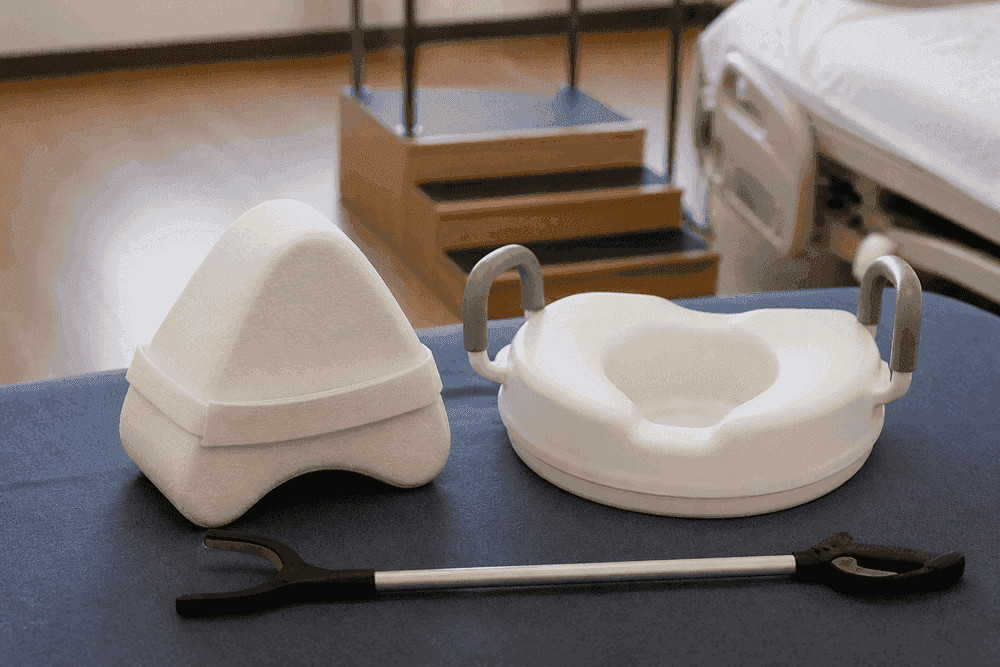
- Posterior approach THA: abduction pillow as ordered; high toilet seat; no bending to tie shoes the forbidden way.
- Use reachers and sock aids so the hip stays in the safe zone.
- Watch for dislocation: sudden pain, limb shortening or rotation. Do not force ROM.
An abduction pillow and raised toilet seat are not comfort props. They block adduction and deep flexion during sleep, transfers, and toileting. Tying shoes by bending at the hip, crossing legs, or pivoting on the operative leg are the everyday moves that break the rule set. If the client reports sudden sharp pain with a shortened or rotated limb, stop ROM and escalate for possible dislocation. Forcing the joint back into place is not a nursing maneuver. Edge case: anterior-approach precautions differ. Follow the stem's approach and the ordered teaching rather than applying posterior rules to every THA.
Traction, casts, and other immobilization devices
Traction
Immobilization devices (skin or skeletal traction, casts, splints) use a pulling or rigid force to align bone, reduce muscle spasm, or protect a repair. Skin traction pulls through boots or wraps; skeletal traction pulls through a pin or wire in bone. Either way, the physics only work if weights hang freely, ropes run in the pulleys without snags, and the client stays in alignment.
- Inspect skin and pin sites per protocol for infection or skin breakdown.
- Keep weights hanging free and ropes unobstructed.
- Neurovascular checks distal to cast or traction.
- Do not remove weights to help the client scoot up without an order.
- Maintain countertraction and body alignment. A slumped client cancels the plan.
The distractor that looks kind is lifting the weights so the client can use the bedpan more easily, or resting weights on a chair overnight. That cancels the therapeutic pull. Get help to move the client while preserving the apparatus, or obtain an order if the plan must change.
Amputation
After amputation, priorities shift among hemorrhage, infection, residual-limb shaping, and contracture prevention. In the immediate postop period, watch the dressing for bright red bleeding and keep a surgical tourniquet available per protocol for catastrophic bleed. Residual-limb elevation may be used briefly early as ordered for edema, but prolonged elevation of a below-knee residual limb encourages hip flexion contracture that ruins prosthesis fit later.
| Focus | Do | Trap |
|---|---|---|
| Hemorrhage | Monitor dressing; escalate bright red saturation | Ignoring a pooling under the residual limb |
| Contracture (BKA) | Prone periods as ordered; limit prolonged elevation later | Pillows under the knee for days |
| Phantom sensation | Acknowledge; treat pain as ordered | Telling the client it is imaginary and dismissing it |
| Figure-wrap / shrinker | Apply as taught for shaping | Uneven wraps that create bulbous ends |
Phantom limb sensation or pain is neurologically real to the client. Acknowledge it, assess residual-limb integrity, and use ordered pain strategies. Dismissiveness destroys trust and misses true residual-limb complications. Gout flares still appear in this topic cluster: rest the joint, meds as ordered, hydrate, and limit high-purine triggers taught for that client (organ meats, some seafood, alcohol as commonly tested).
Priority map
| Picture | First move |
|---|---|
| Cast pain 10/10 + passive stretch agony | Compartment escalate |
| Cool, numb toes distal to cast | Full neurovascular check; notify |
| Femur repair + confusion + petechiae | Fat embolus pathway |
| THA client tying shoes with deep bend | Stop. Reteach precautions |
| Weights on the floor | Rehang freely; reassess alignment |
| BKA residual limb on pillows for days | Correct positioning; contracture prevention |
Revision
Must know
- 1Compartment syndrome: pain out of proportion, worse with passive stretch, tight swelling, paresthesia. Report immediately. Do not elevate above heart as the only fix.
- 2Neurovascular six Ps: pain, pressure/pallor, paresthesia, paralysis, pulselessness (late), poikilothermia (cool). Early pain and paresthesia matter more than a lost pulse.
- 3Fat embolism after long-bone fracture or repair: sudden confusion, hypoxia, petechial rash. Oxygen and escalate.
- 4Rhabdomyolysis after crush or a long lie: cola urine, rising CK and potassium. Aggressive IV fluids as ordered; this is not a UTI lecture.
- 5Posterior hip precautions: no flexion past about 90°, no adduction past midline, no internal rotation as taught.
- 6Traction: weights hang free; never remove or lift weights without an order. Ropes unobstructed; alignment maintained.
- 7Cast: keep dry; report cool, pale, or numb digits and severe unrelieved pain. Petal rough edges; never insert objects to scratch.
- 8BKA residual limb: avoid prolonged elevation after the early period when ordered; prone positioning helps prevent hip flexion contracture as taught.
- 9Phantom limb sensation is common. Acknowledge it; distinguish from surgical-site infection or residual-limb ischemia.
- 10Gout self-care: hydrate, limit high-purine foods and alcohol as taught, take acute meds for flares.
Memory hooks
Pain with stretch = compartment
Passive stretch that skyrockets cast or fracture pain is a surgical emergency cue.
Weights must swing
Traction weights hang freely. Resting them on the floor cancels the pull.
90, cross, twist: don't
Posterior hip precautions block deep flexion, crossing legs, and internal rotation.
On the exam
How it's tested
Stems show unrelieved cast pain, petechiae after a femur fracture, a client crossing legs after THA, weights on the floor, or a residual limb propped on pillows for days. Distractors remove traction weights, elevate a compartment limb high above the heart as the whole plan, or treat fat embolism confusion as hospital anxiety.
More in adult health
All topics- Acute coronary syndromesNCLEX ACS chapter: STEMI reperfusion, nitroglycerin and cath-site priorities, cardiogenic shock, tamponade and endocarditis cues, and valvular stenosis vs regurgitation.Read
- Acute respiratory emergenciesNCLEX airway map: failure cues, PE vs pneumothorax vs obstruction, oxygen and positioning priorities, and when to escalate.Read
- AnemiasNCLEX hematology chapter: iron, B12, and folate deficiency teaching, anemia activity tolerance, and sickle-cell crisis priorities with emergency red flags.Read
- Antimicrobial therapyNCLEX antimicrobial chapter: allergy checks, finishing the course, vancomycin flushing, aminoglycoside toxicity, TB drug teaching, and common topical agents.Read